WoW Midnight Herbalism Guide: Leveling and Specializations
Midnight Herbalism is easy to begin while questing, but reaching skill 100 is only one part of developing the profession. Knowledge, equipment, plant variants and time spent at each stop all affect your results. Start with an affordable equipment set and a manageable route. Then spend Knowledge toward a clear goal: mounted gathering, larger herb harvests or better interactions with infused plants.
This guide covers Season 2 in the context of patch 12.1.5. It separates the profession's core systems from seasonal plants. It does not assign a fixed gold return to a route. Competition, specialization and material prices can change the value of the same gathering session.
Learn Midnight Herbalism from Botanist Nathera in Silvermoon, around 48.2, 51.6. Make sure you have learned the expansion-specific profession, enable herb tracking and leave room for reagents. Skill from an earlier expansion does not replace your Midnight skill entry.
Choosing a second profession
Alchemy and Inscription let you use your own harvest. Mining offers a second set of resources to sell during the same outing, provided ore stops do not constantly pull you away from your herb route. Compare demand, expenses and how you prefer to gather instead of choosing a pairing around one unusually expensive item.
The herbs and their different variants
Midnight has five main herbs. Nocturnal Lotus is an additional rare find from different herb nodes, rather than a sixth ordinary plant you must locate separately. Reagents that use quality have two quality ranks. Keep those ranks separate when valuing a harvest.
Material | What to know | Practical use |
Tranquility Bloom | The ordinary version stops granting skill early | Useful for starting out and mixed gathering |
Argentleaf | One of the five main herb types | Compare its price with how often your route supplies it |
Azeroot | A main herb with its own specialization branch | Worth specializing in when you gather it regularly |
Mana Lily | Often found near or in water | Check shorelines, but include the descent in your travel time |
Sanguithorn | Has a dedicated herb specialization | Evaluate price together with availability |
Nocturnal Lotus | A rare additional harvest | Track separately from ordinary herbs |
A herb's name does not tell you everything about the stop. Lush plants yield more herbs, but they are not infused nodes: they provide no mote side gather and cannot be overloaded. Transplanted plants in Voidstorm are weaker-yield versions. Neither ordinary nor Lush Transplanted plants can be overloaded. Identical base herbs can therefore have quite different value along a route.
Leveling Herbalism from 1 to 100
Skill and Knowledge progress alongside each other but serve different purposes. Base skill opens access to specialization trees; Knowledge is spent within them. Profession equipment improves gathering performance without replacing the base-skill requirements for opening trees.
Base skill | What to gather | What to watch |
1-30 | Any accessible Midnight herbs | Begin with a safe loop near your quest objectives |
30-60 | Other main herbs and suitable advanced variants | Ordinary Tranquility Bloom is gray; the other ordinary herbs can still grant skill |
60-100 | Lush and suitable infused plants | Ordinary main herbs no longer advance skill |
A yellow entry does not guarantee a skill point on every gather. Gray plants still provide materials, so you can collect them for sale even when you need a different variant for leveling. A long flight to a single plant may not be worth the chance of one skill increase.
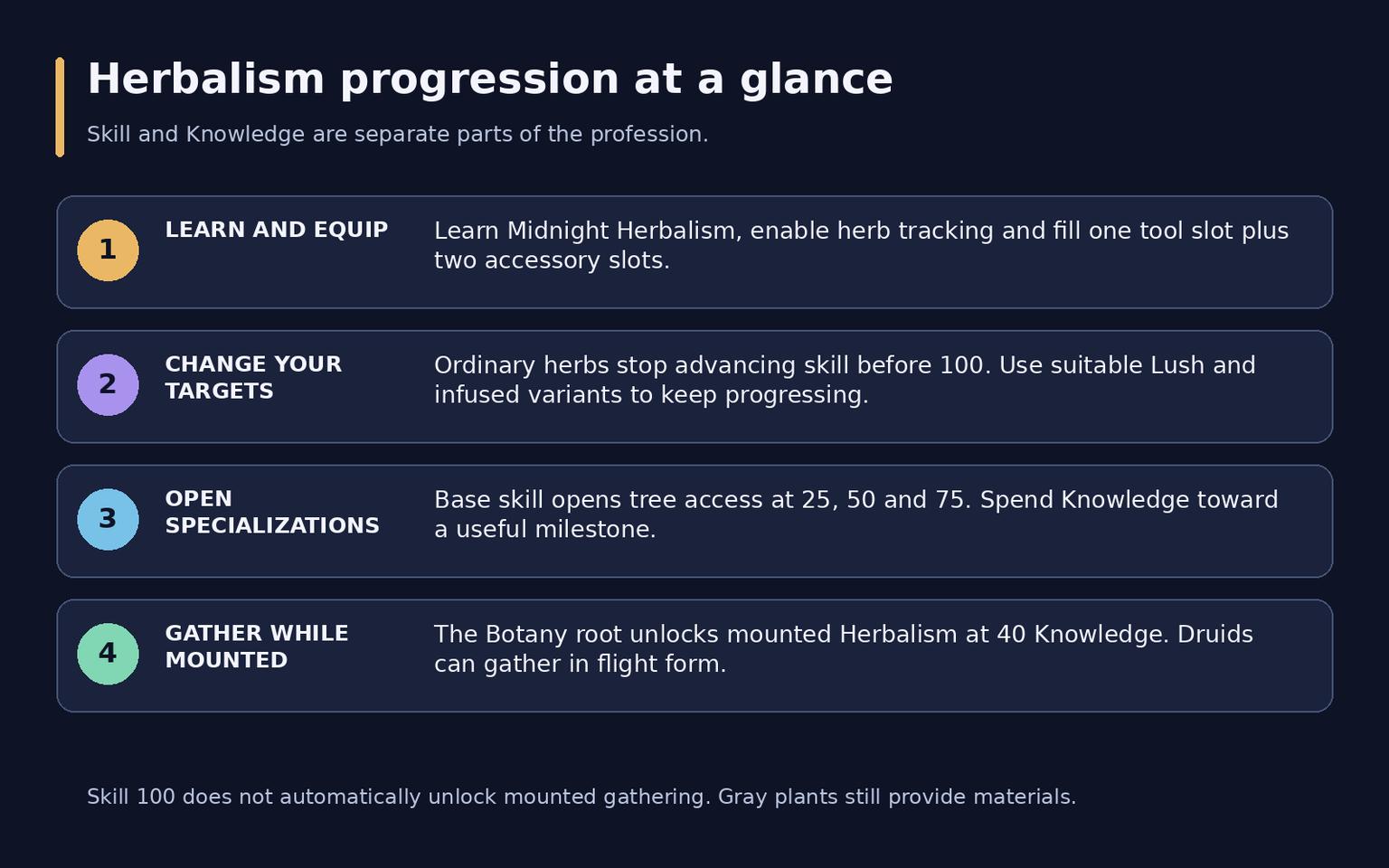
The first, second and third specialization trees become accessible at base skill 25, 50 and 75. You can make meaningful specialization choices before reaching 100. Choose the next useful milestone first, then spend toward it; scattering Knowledge across several branches delays those benefits.
Specializations: convenience, herbs or Overload
Herbalism has three main trees. Their ideal order depends on your character and the plants you intend to gather.
Tree | Main purpose | When to prioritize it |
Botany | General gathering stats and mounted Herbalism | Usually first for characters without flight-form gathering |
Bountiful Harvests | Ordinary herb yields and individual herb branches | For consistent collection of your chosen plants |
Midnight Overload | Infused-node interactions | When these stops make up a meaningful part of your route |
A practical starting path
Putting 40 Knowledge into the Botany root unlocks mounted gathering for Midnight herbs. This is a separate benefit, not a reward automatically granted at skill 100. Afterward, the Bountiful Harvests root is a reasonable next investment, followed by a branch for a herb you actually gather. A high price does not make a herb branch useful if that plant rarely appears on your route.
Druids can gather herbs in flight form, which can make an earlier investment in harvest yields attractive. However, an old mount shortcut should not determine your plan. Blizzard's official rules remove the default mounted-Herbalism benefit of the Sky Golem and Mechanized Lumber Extractor in Dragonflight and newer expansion zones. Ordinary mounted gathering there relies on the relevant profession unlock.
Side branches and consumables
Individual herb branches in Bountiful Harvests improve gathering for their own plant. Completing one increases the frequency of Nocturnal Lotus finds from that herb. It does not guarantee a Lotus from every node.
Botany's Mulching branch enables consumables that improve your next gather. Once activated, a mulch effect lasts up to five minutes and ends after gathering one plant. It is not a persistent buff for an entire long route. Cultivation develops seed gathering and planting: use Rich Soil, generally near water, and gather the resulting plant. Progression opens additional seed types. Planting is another way to obtain herbs, not a requirement for gathering ordinary wild plants.
Infused herbs and Overload
Your first infused herb gather teaches Overload Infused Herb. Gathering normally and using Overload create different interactions. Further gathering reduces the ability's recovery time, while developing the Midnight Overload root provides access to another charge.
Family | Normal gathering interaction | Preparing to overload |
Lightfused | Falling-mote markers appear | Choose open, level ground and watch your health |
Wild | Lashers spawn and can be harvested after defeat | Prepare for an elite enemy and a temporary Perception benefit |
Primal | The interaction involves damage and motes | Start with enough health and avoid accidentally breaking the channel |
Voidbound | A hazardous Void area appears | Consider the reality tear and whether you have a return portal unlocked |
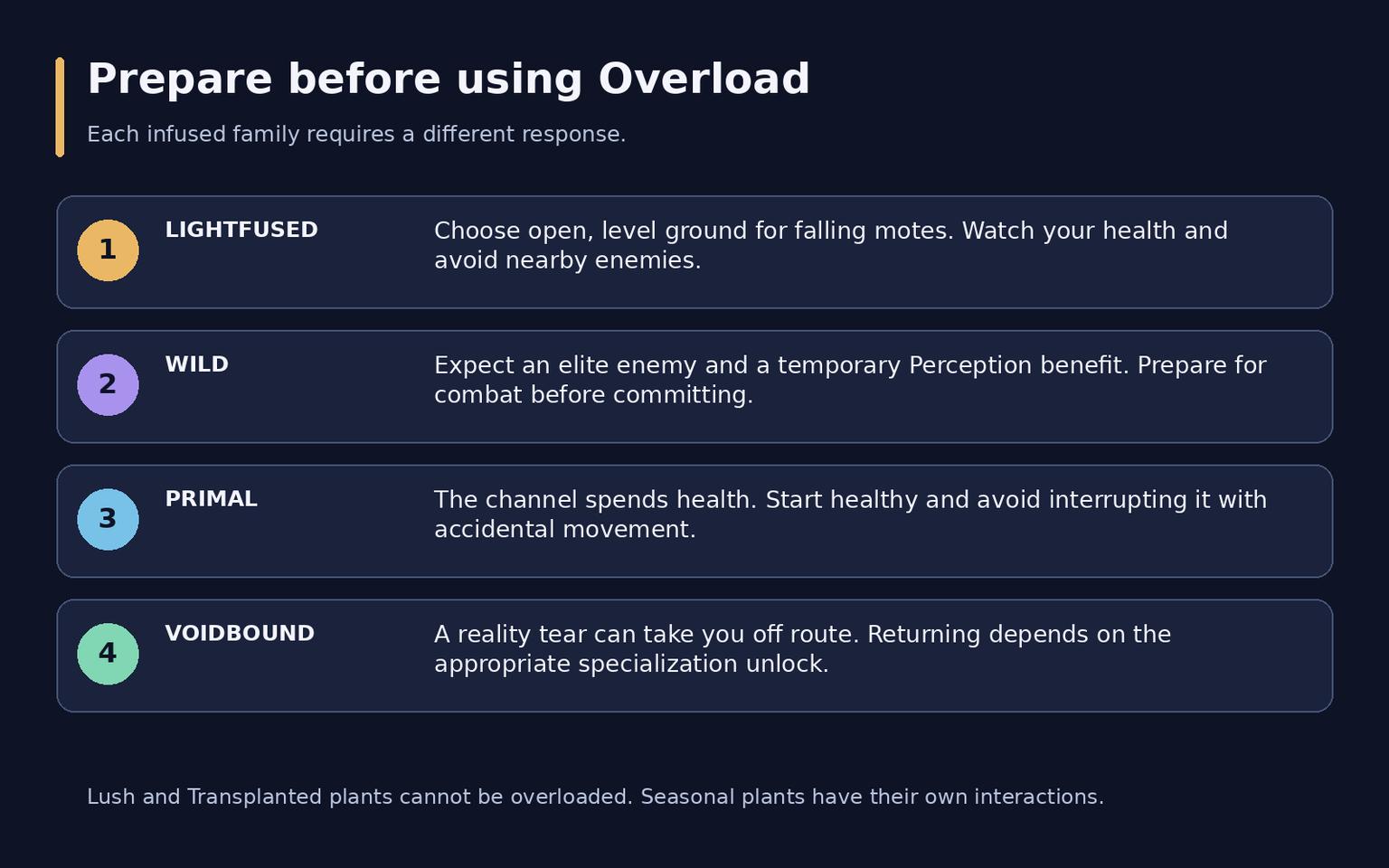
Open terrain makes Lightfused overloads easier to manage. Slopes, obstacles and nearby enemies can make you miss falling motes. Primal overloads spend health during a channel, and moving interrupts it. Avoid beginning under attack, and do not assume the extra materials always justify the risk.
A Wild overload summons an elite enemy for a temporary Perception benefit. That is a different interaction from harvesting the ordinary lashers; Overload does not follow a universal rule of simply producing another bundle of motes. Voidbound can transport you to a random location, potentially in another zone. Returning depends on the appropriate branch unlock. Without it, the trip can disrupt your entire gathering loop.
Season 2 plants
The Coiled Isle can become affected by Cursed Land and Waters after a Curse Surge. Envenomed Tranquility Bloom needs cleansing, after which green globules provide Neutralized Venom Clots. Other players can also collect those globules, so do not linger after the interaction.
Cursed Tranquility Bloom is associated with Cursebound Globes and can be overloaded for additional seasonal reagents. Do not assume the Envenomed version follows the same rule. These plants add seasonal options without replacing the five main herbs or the four original infused families.
Knowledge: first discoveries and the weekly routine
Discovering plant variants provides up to 34 one-time Knowledge: five ordinary herbs, five Lush versions, twenty combinations of five herbs and four infused families, plus the first overload of each infused family. These are discovery rewards, not a weekly allowance. Gathering the same variant again does not repeat its first-discovery reward.
Eight Herbalism treasures provide another 24 one-time Knowledge. Traditions of the Haranir: Herbalism and Echo of Abundance: Herbalism give 10 each; check the vendor's requirements and price before purchasing. Collect available one-time rewards first, then build a repeatable weekly routine.
Weekly source | Knowledge | How to count it |
Profession quest | 3 | Check availability with the trainer |
Five Thalassian Phoenix Plumes and one Phoenix Tail | 9 | Five items worth 1 each and one worth 4 |
Thalassian Treatise on Herbalism | 1 | Usable once per week |
That makes up to 13 regular weekly Knowledge before catch-up. If the profession quest is missing, check its current unlock conditions and your base profession skill. Access to a quest is not the same as automatically receiving its reward.
Thalassian Phoenix Ember is a catch-up item worth one Knowledge. It is not an unlimited extra supply for a character who has already collected the available amount. The Darkmoon Faire profession quest awards three Knowledge per monthly cycle and is separate from the normal weekly 13.
Equipment, gathering stats and expenses
A full profession set has one tool and two accessories. Filling empty slots is usually a better starting point than immediately buying the most expensive version of a single piece. Other crafters make the basic equipment.
Equipment | Crafted by | Slot |
Thalassian Sickle | Blacksmith | Tool |
Bright Linen Herbalism Hat | Tailor | Accessory |
Eversong Botanist's Satchel | Leatherworker | Accessory |
Finesse helps with additional ordinary materials, Perception concerns rare finds and Deftness reduces gathering time. Their relative value depends on whether you want base herbs or rare reagents. Improving one stat does not remove the importance of skill, specialization or a manageable route.
Artisan Herbalist's Moxie is the profession's own currency for relevant purchases and improvements. Do not treat it as a shared pool for every profession. Before ordering expensive equipment, compare the extra stats with the cost. Evaluate gathering consumables over several sessions; a lucky Lotus does not prove that every use of mulch pays for itself.
Choosing a route without fixed income claims
Start with a short, safe loop. Compare two sessions of the same length, such as 20 minutes, using the same equipment conditions. Record base herbs by type and quality, rare materials and consumable expenses. Include fights, searches beneath ledges and time spent returning from overload interactions.
A Mana Lily beside an accessible shoreline can be a better stop than a higher-priced herb on an awkward ledge. A long descent for a single plant can reverse that result. Judge materials obtained across the whole session rather than the price of one successful gather.
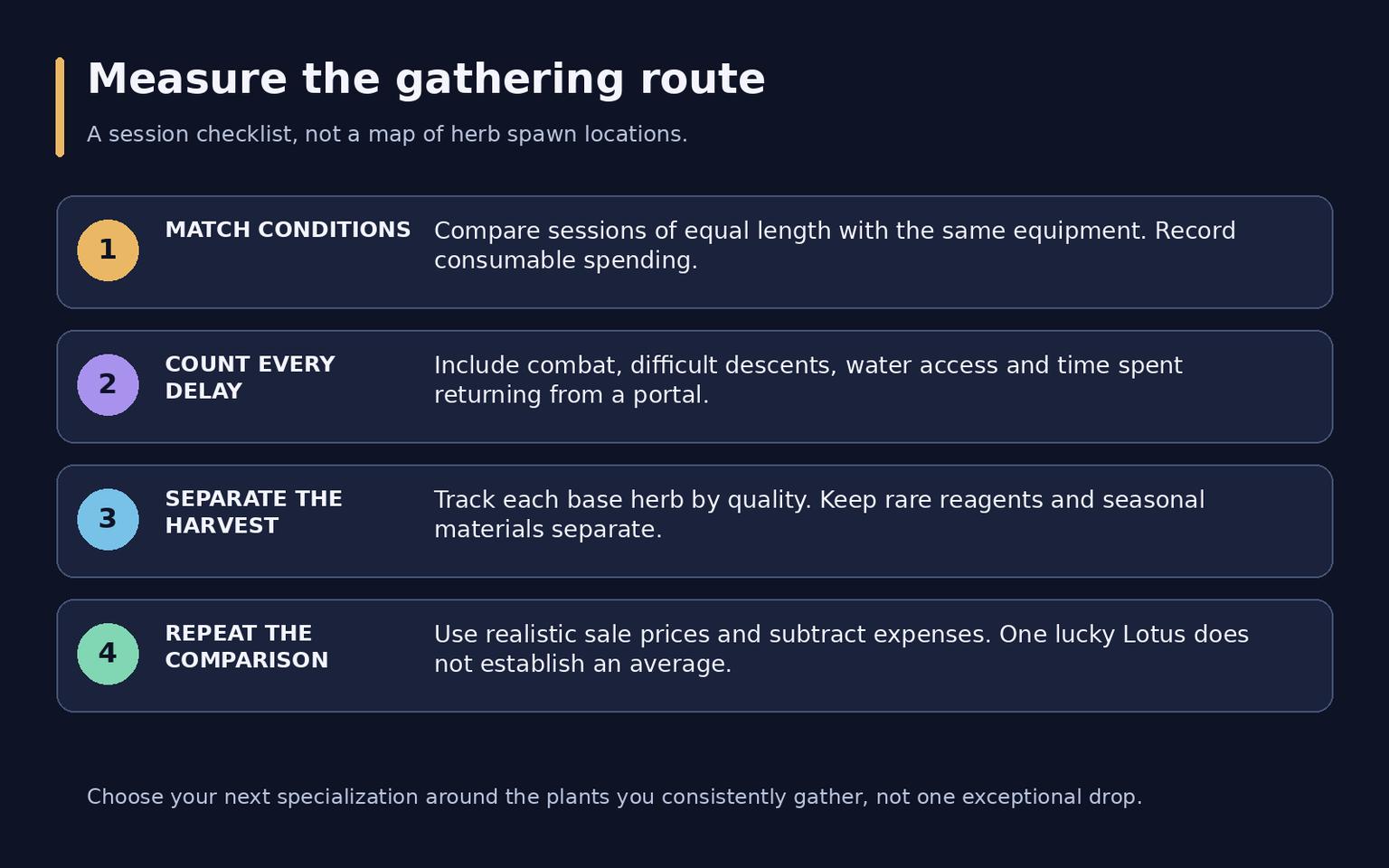
Repeat the comparison using realistic sale prices and subtract your expenses. Choose later specialization investments around the stops you actually make. Herbalism becomes easier to plan when your build, preferred materials and route support each other, but none of those choices guarantees a fixed hourly profit.
Frequently asked questions
Do I need skill 100 before specializing?
No. The first tree opens at base skill 25. You can collect Knowledge and useful discoveries while leveling.
Can I overload Lush plants?
No. Lush is a higher-yield ordinary variant, not an infused family. Transplanted plants also cannot be overloaded.
How should I start without a Druid?
Learn the profession, fill all three equipment slots and work toward 40 Knowledge in the Botany root for mounted gathering. Until then, choose safe places to dismount.
Which Knowledge sources should I check weekly?
The quest, Phoenix Plumes and Tail, then the treatise. Track first discoveries, treasures, catch-up and the monthly Faire separately.