WoW Midnight Inscription Guide: Leveling, Treatises and Builds
Inscription supplies other crafters with inks, missives and treatises while also producing weapons, profession tools, Darkmoon cards and housing decor. Access to that range does not make developing every product at once practical. Knowledge follows separate paths, and knowing a recipe does not establish that it is worth producing. Choose what your characters or customers need before committing to a specialization.
This guide was checked on October 16, 2026 for Midnight Season 2 in the context of patch 12.1.5. It covers materials, leveling to 100, the four trees, equipment and Knowledge sources, with seasonal recipes discussed separately. Market prices change, so the guide does not prescribe a universal shopping list or promise a gold return.
Goal | Relevant direction | First check |
Treatises for your characters | Calm Hands | Recipe access and weekly consumption |
Reagents for sale | Perfected Products | Herb, pigment and finished ink prices |
Weapons and profession tools | Blueprints | The specific recipe and available orders |
Cards and upgraded trinkets | Darkmoon Curiosity | Full deck cost and the suit you need |
Training and your second profession
Zantasia teaches Midnight Inscription in Silvermoon City, around 46.9, 51.6. Make sure you train the expansion's own skill; earlier profession bars do not replace it. Return for new recipes as your skill develops, especially when your current leveling method stops awarding points.
Herbalism offers direct material supply: herbs become pigments, which become inks. Another crafting profession is also workable if you buy materials. Alchemy shares some inputs but does not inherently make Inscription cheaper. Self-gathered herbs still have a market value even if no auction purchase was involved.
Nightborne receive +5 Inscription skill and Kul Tirans +2 profession skill. These bonuses can help around a quality threshold, but neither replaces Knowledge or equipment. There is no mandatory class for Inscription, and a modest racial advantage need not determine which character you play.
From herbs to inks
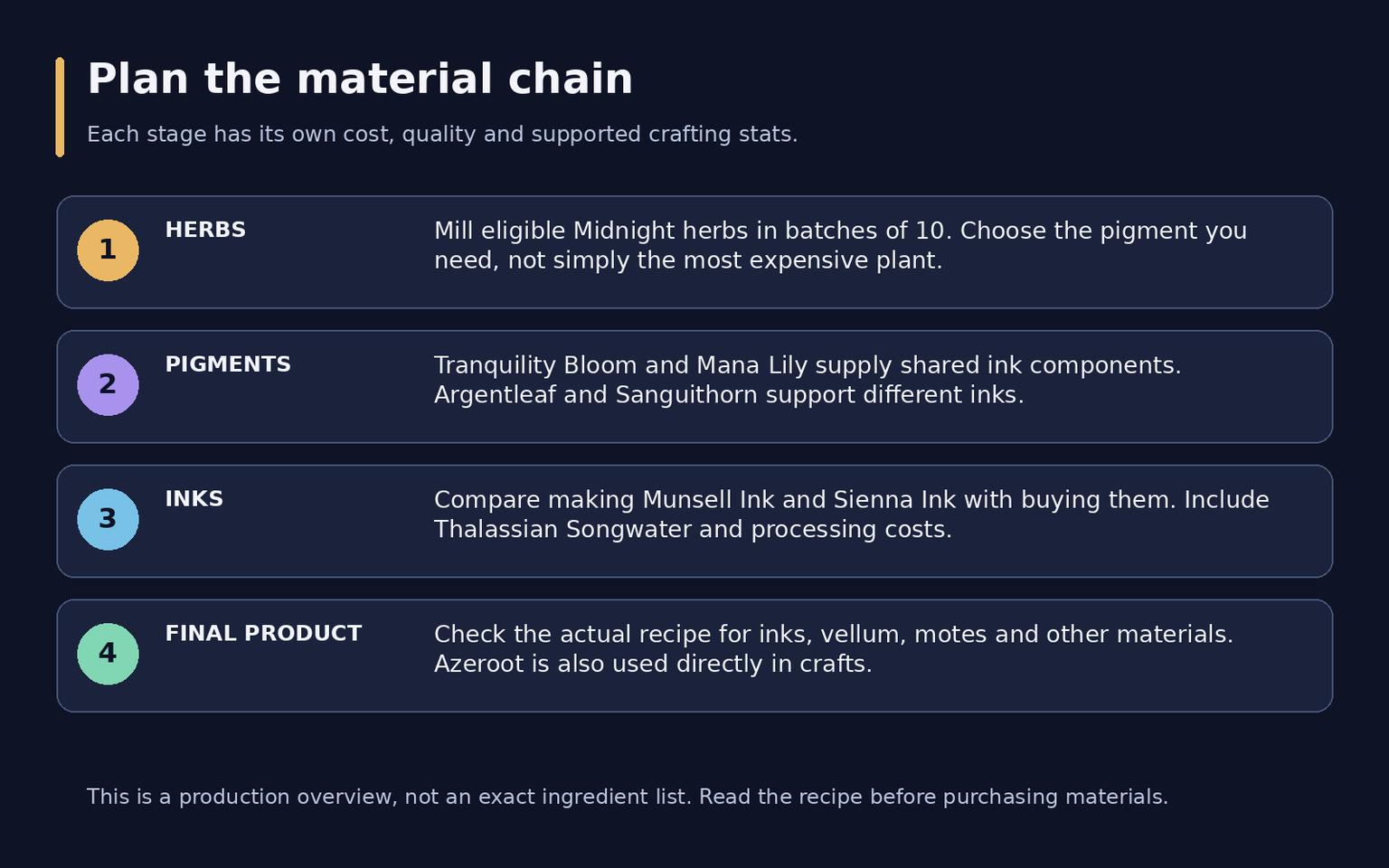
Midnight Milling consumes herbs in batches of 10. Choose the input deliberately: different pigments serve different recipes, and the most expensive herb is not necessarily the right one for the current task. The two main inks combine shared ingredients with a pigment specific to that ink.
Herb | Production role | Output is used for |
Tranquility Bloom | Common pigment source | Both main inks |
Mana Lily | Another shared pigment component | Both main inks |
Sanguithorn | Ink-specific pigment | Munsell Ink |
Argentleaf | Ink-specific pigment | Sienna Ink |
Azeroot | Used directly in recipes | Weapons, tools and Codified Azeroot |
Thalassian Songwater is used in inks and some other crafts. Together with purchased vellum, it is an easy expense to overlook when comparing prices. Milling herbs and making inks are separate operations, each with its own costs and relevant crafting stats.
Later recipes use materials such as ciphers and Codified Azeroot. Treatises also need motes, with the type depending on the profession the treatise serves. Read the individual recipe rather than assigning one costly intermediate reagent to every Inscription product.
Leveling Inscription from 1 to 100
Suitable crafting and processing actions raise skill. Knowledge develops specialization trees, while consuming a treatise awards Knowledge on a weekly limit. These are separate actions: crafting dozens of treatises for skill does not let you immediately claim the same number of Knowledge points.
A practical route begins with milling, moves into available first crafts and then uses treatises. The first tree opens at base skill 25, followed by the others at 50, 60 and 75. For a treatise route, unlock Calm Hands early to learn Thalassian Treatise on Inscription.
Skill stage | Practical approach | Limitation |
Roughly 1-20 | Mill the Midnight herbs you need | Batch count depends on actual skill gains |
Roughly 20-30 | Make inks and available simple items | Keep useful materials for later stages |
Roughly 30-50 | Complete first crafts and add treatises | Learn new recipes instead of repeating unnecessary items |
50-100 | Continue useful treatises and suitable orders | The final points can require additional crafts |
Enable the first-craft bonus filter in your journal to find recipes with an unclaimed reward. A new technique is not automatically a sensible purchase: compare the unlock cost, materials and usefulness of its output before buying it.
Crafting treatises can discover treatise recipes for other professions. Spread production across your characters' needs and available orders instead of accumulating a huge supply of one weekly consumable. Treatises are Warbound and can be passed to your other characters. They are not ordinary freely tradable auction-house stock.
Watch recipe color as you approach 100. Yellow and green recipes do not guarantee a point per action. Weapon orders offer another route if you know the recipe and can meet the requirements. Check the customer's personal reagents and quality target first. These differences make a fixed material allowance for the entire leveling process unreliable.
Four trees and practical development plans
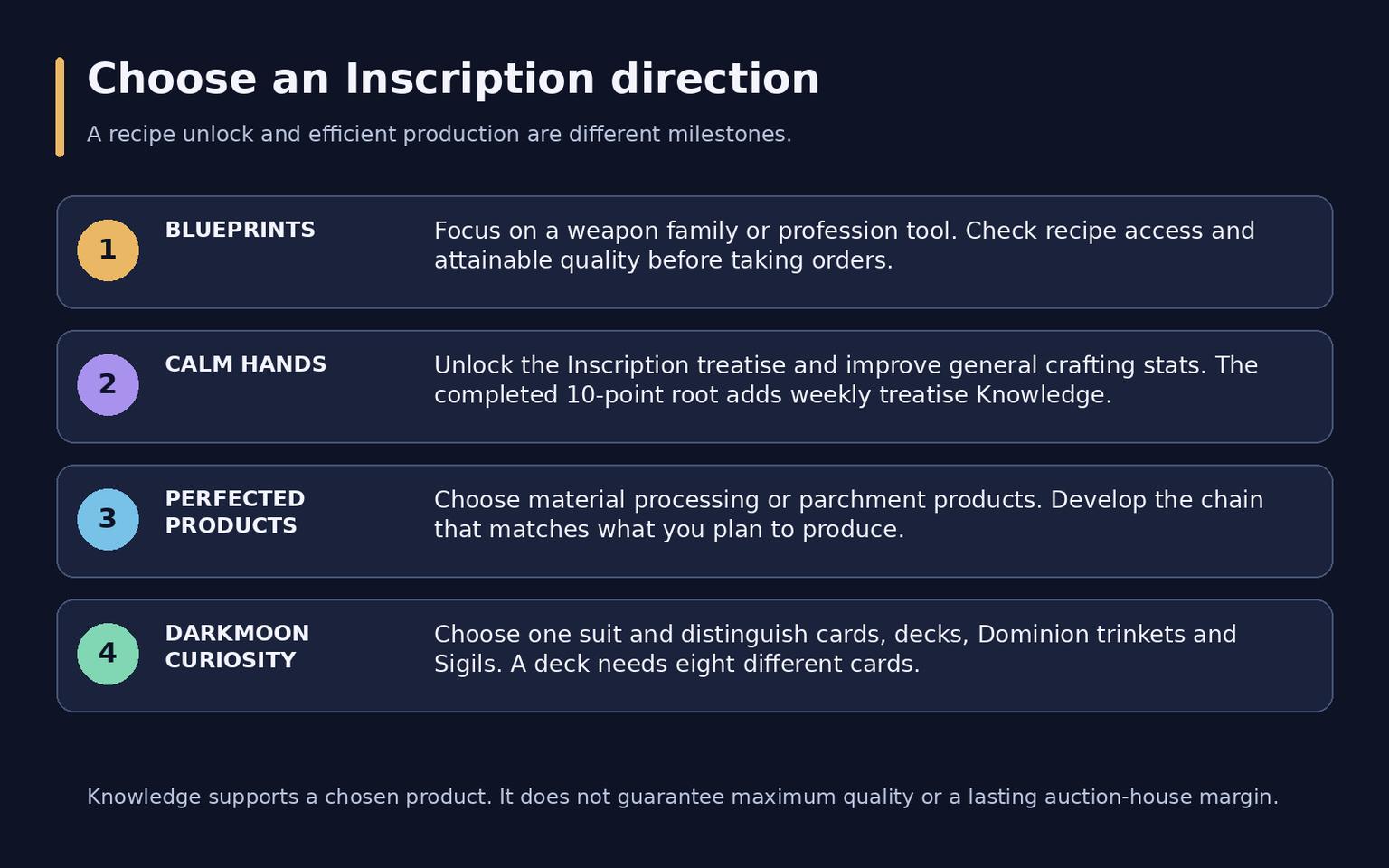
All trees can be developed over time, but early Knowledge works better when it supports a specific product. Recipe access and production efficiency are separate objectives. Confirm that the branch you intend to follow actually leads to the item you want.
Tree | What it develops | Useful initial focus |
Blueprints | Weapons and profession tools | One weapon family or one tool |
Calm Hands | General crafting stats and the treatise | Accessible leveling and later efficiency |
Perfected Products | Reagents, missives, contracts and Vantus Runes | One production chain |
Darkmoon Curiosity | Cards, trinkets and Sigils | One suit and its intended final product |
Treatises and general efficiency
Unlocking Calm Hands teaches the initial treatise. Completing its 10-point root increases your own weekly treatise reward from 1 Knowledge to 2. This does not require completing every branch in the tree. Consider the benefit before consuming your next treatise if you are about to finish that root.
One subsequent plan for volume crafting is 10 points in the root, 20 in Dextrous Diligence and 20 in Keen Eye. That is 50 Knowledge aimed at Multicraft and Resourcefulness. It is an example of prioritizing stats, rather than a guarantee of profit or maximum quality. Your particular product still needs its own specialization development.
Reagents, missives and contracts
Perfected Products separates material processing from parchment products. Develop the ink chain if you sell inks, or the appropriate missive branch if that is your product. Missives set secondary stats when crafting equipment, contracts support reputation gains and Vantus Runes serve raid encounters. Their demand comes from different uses.
Before each investment, identify what is currently holding you back: insufficient skill for the target quality, a missing recipe or excessive production cost. Improving pigments does not automatically make every other Inscription item a top-quality product. Buying finished inks can sometimes support your chosen business without developing the entire herb-processing chain yourself.
Weapons and profession tools
Blueprints supports staves, off-hands, bows and tools for Alchemy, Cooking and Inscription. Choose one chain, then develop its connected nodes. Splitting early Knowledge equally among weapon families expands your options while delaying improvement in the item you intend to make most often.
Before accepting an order, inspect supplied reagents, requested quality and Concentration use. Any maximum-quality commitment should be supported by the crafting window's calculation. Reaching a particular Knowledge total does not replace base skill, equipment or the correct materials.
Darkmoon cards
Darkmoon Curiosity lets you craft cards in four suits: Rot, Blood, Hunt and Void. A deck needs all eight distinct cards of one suit. Duplicates do not fill missing numbers. Transcribing provides another way to work on a suit's composition, but also consumes resources.
Distinguish the deck, the upgraded Darkmoon Dominion trinket and the Darkmoon Sigil embellishment. They are different products with their own recipes and requirements. Choose your route after checking the full set cost and the intended character's needs. An expensive trinket listed on the auction house does not by itself demonstrate steady demand for your chosen suit.
Quality and profession equipment
Midnight reagents and consumables that use quality have two ranks. Crafted equipment retains five quality ranks. These ranks are separate from item rarity: an epic tool and a rank-five craft describe different properties.
A scribe equips one tool and two accessories. You can fill the starter slots before committing to expensive upgrades.
Item | Crafted by | Equipment slot |
Hobbyist Scribe's Quill | Scribe | Tool |
Fantastic Font Focuser | Jewelcrafter | Accessory |
Bold Biographer's Bifocals | Jewelcrafter | Accessory |
Multicraft helps eligible batch recipes, while Resourcefulness can preserve materials. Do not budget for Multicraft when milling or crafting weapons. Ingenuity relates to Concentration refunds; Concentration helps reach higher quality where a recipe permits it. Its regenerating supply limits how much you can produce this way.
Choose a tool for the operation and inspect the recipe's supported stats. An ink batch and a weapon order can call for different priorities. Judge expensive equipment by its effect on attainable quality and costs, rather than its name color alone.
Knowledge sources
First crafts provide one-time rewards marked in the journal. Eight Inscription treasures award 3 Knowledge each, for 24 total. The one-time Traditions of the Haranir: Inscription book adds 10 Knowledge and requires Midnight Inscription 25 plus renown 6 with the Hara'ti. Check the vendor's current price in Harandar before buying.
Artisan Scribe's Moxie belongs to Inscription: do not treat another profession's balance as interchangeable. Match recipe and Knowledge-book purchases to your next development objective instead of spending on everything available.
Source | Reward or schedule | Planning consideration |
Weekly crafting-order quest | Thalassian Scribe's Journal: 4 Knowledge | Check quest requirements and claim the reward |
Two weekly treasure items | 4 Knowledge in total | Separate these from the eight one-time treasures |
Thalassian Treatise on Inscription | 1, or 2 with the root bonus | Consumed once per week |
NPC Patron orders | Rewards vary by order | Not every order grants Knowledge or is achievable |
Darkmoon Faire | 3 Knowledge per monthly cycle | Track separately from the weekly routine |
If the crafting-order quest is missing, check the introductory crafting questline. Order-based catch-up helps characters who are behind; it is not unlimited additional Knowledge after reaching the current allowance. Track one-time rewards, regular weekly sources and catch-up separately.
What to check in Season 2
Seasonal additions include Vantus Rune: Tides, Contract: Zul'jarra's Forces, the Cursed Gaze of Ula'tek Mural and Chiseled Amani Tablet. These are examples of new recipes, rather than a complete decor catalog. Recipe sources and purchase requirements need checking separately from profession skill.
Use the current seasonal reagents when crafting or recrafting equipment. Do not apply a Season 1 item-level or upgrade-cost table to a Season 2 order. Before buying materials, make sure the products you are comparing match in quality, season and purpose.
Checking the cost of a batch
Start with a small quantity of one product. Record the value of purchased and gathered inputs, including water, vellum and intermediate materials. Calculate output without chance-based bonuses, then compare that cost with a realistic selling price after auction expenses.
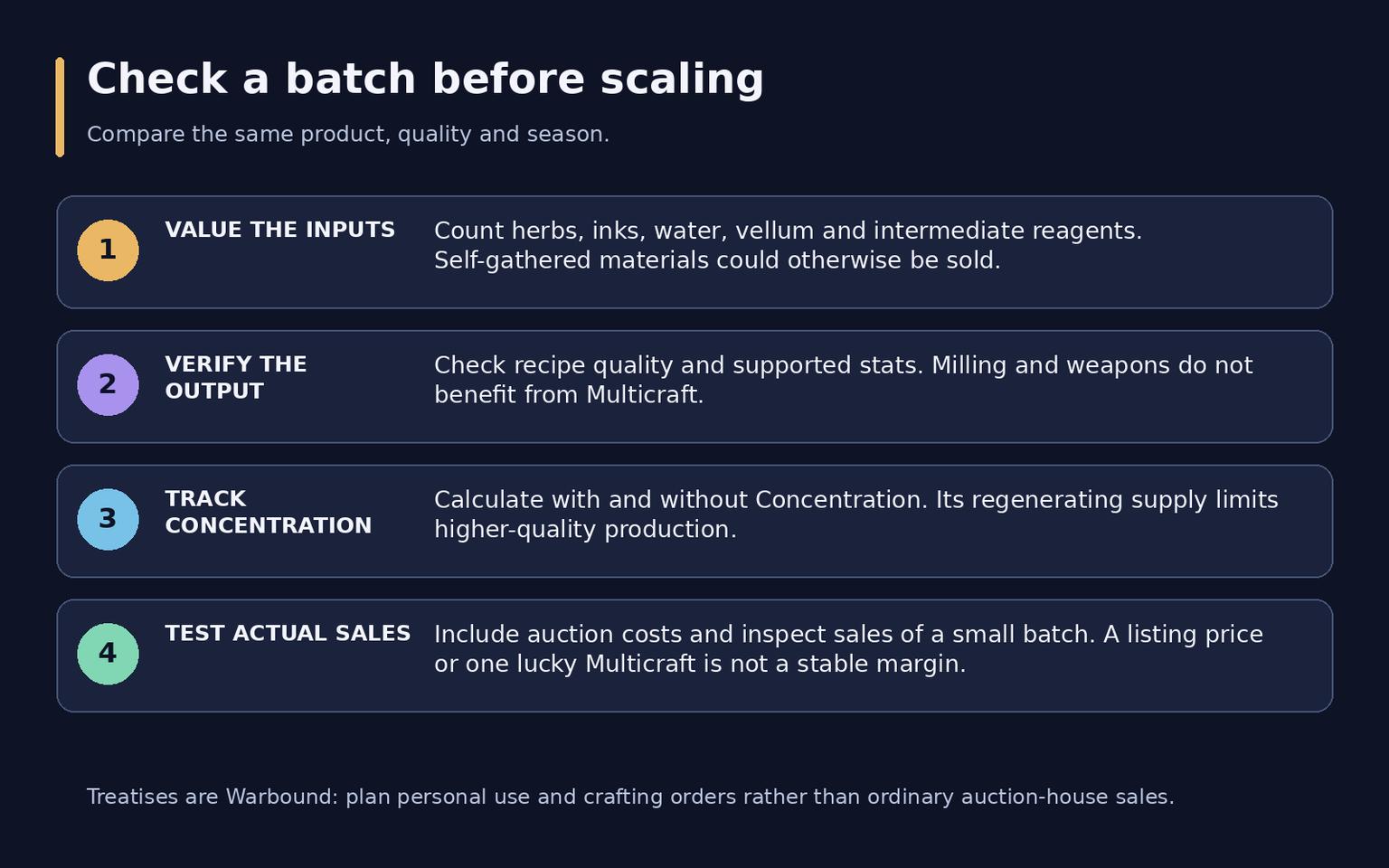
Evaluate production with and without Concentration separately. One fortunate Multicraft result does not establish a lasting margin. If an item sells slowly, producing more merely ties up additional gold in stock. For personal use, compare your costs with buying the finished item. For orders, account for material and Concentration use at the offered payment.
Frequently asked questions
Can treatises take Inscription to 100?
Yes, after unlocking the recipe through Calm Hands. The final points can require extra crafts. Plan useful treatises for your Warband and available orders instead of only repeating one recipe.
Does every crafted treatise give Knowledge?
Crafting and consuming are different actions. Weekly consumption of your Inscription treatise gives 1 Knowledge, or 2 with the completed Calm Hands root. Producing stock does not remove the limit.
Must I mill my own herbs?
No. You can buy pigments or inks and focus on your selected final product. Compare the whole chain's cost, attainable quality and processing time.
Which direction guarantees gold?
None. General demand does not establish an individual scribe's profit. Check material costs, quality, Concentration use and actual sales of small batches.