WoW Midnight Jewelcrafting Guide: Leveling, Gems and Builds
Jewelcrafting covers cut gems, rings and necklaces, profession accessories and reagents. You can serve crafting-order customers or process materials for sale, but these activities need different Knowledge investments and stats. Begin with a final product in mind: one gem family, an equipment category or a specific material-processing operation.
This guide was checked on October 16, 2026 for Midnight Season 2 in the context of patch 12.1.5. It covers training, prospecting and crushing, leveling to 100, specializations, equipment and Knowledge. Seasonal recipes are discussed separately. Material costs and demand change, so there is no universal shopping list or fixed income promise.
Goal | Direction | Check before starting |
Gems for equipment sockets | Cutting one gem family | Required stats and quality |
Rings and necklaces | One jewelry category | Recipes, materials and available orders |
Reagents for other crafters | Batch production | Production cost and actual sales |
Gems and dust from raw materials | Prospecting and crushing | Ore type, relevant nodes and output value |
Training and your character
Amin teaches Midnight Jewelcrafting in Silvermoon City, around 48.2, 55.1. Train the current expansion's skill and return for new recipes as it develops. If you are new to the profession, check basic training and the tools required to start crafting.
Mining is a convenient partner for gathering your own ore. That ore still has a value: you could sell it instead of prospecting it. Another crafting profession also works if you buy inputs. Alchemy broadens your product range but does not inherently improve your gem yield.
Draenei receive +5 Jewelcrafting skill and Kul Tirans +2 profession skill. These bonuses help around quality thresholds without replacing Knowledge, materials or equipment. Jewelcrafting is available to different classes; you do not need a particular class simply to use crafted rings or gems.
Ore, uncut gems and gemdust
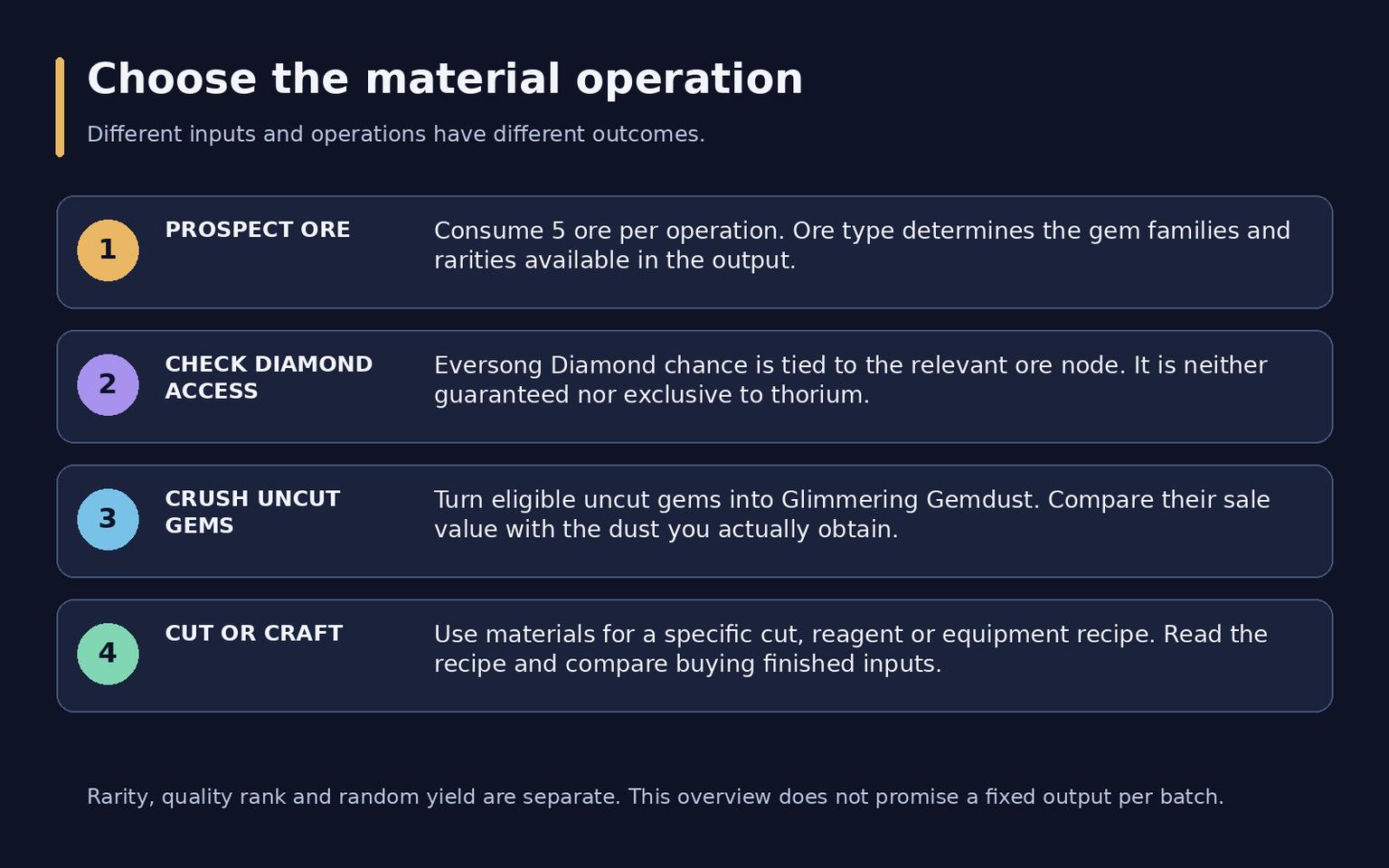
Prospecting consumes ore in batches of 5 and produces uncut gems alongside other materials. Crushing consumes uncut gems for Glimmering Gemdust. These are different operations: do not choose an input solely by its unit price or count every possible gem as part of the same expected result.
Ore | Main gem families | Distinguishing feature |
Refulgent Copper Ore | Garnet, Peridot, Lapis and Amethyst | Uncommon gems from all four families |
Umbral Tin Ore | Peridot and Amethyst | Uncommon and Flawless versions are possible |
Brilliant Silver Ore | Garnet and Lapis | Uncommon and Flawless versions are possible |
Dazzling Thorium | All four families | Flawless gems; evaluate separately from ordinary ore |
The main uncut gems are Sanguine Garnet, Harandar Peridot, Amani Lapis and Tenebrous Amethyst, with Flawless counterparts also available. Keep gem rarity separate from quality rank: a Flawless input and a rank-two input describe different properties.
Eversong Diamonds need additional attention. Access to their prospecting chance is tied to the relevant ore nodes in Proficient Processor. A diamond is neither a guaranteed result nor a reward available only from thorium. Check your node and the batch cost before processing a large stockpile.
Duskshrouded Stone and Crystalline Glass serve other recipes, while gemdust supports cutting and production. Compare selling an expensive gem directly with crushing it. Rarity alone does not establish that turning it into dust is better than processing cheaper inputs.
Leveling Jewelcrafting from 1 to 100
Suitable processing and crafting actions raise skill. Knowledge is invested inside specializations and is a separate progression system. The first tree opens at base skill 25, followed by the others at 50, 60 and 75. Choose it for your next intended product rather than a claim that one direction always makes the most gold.
Up to 50, trainer recipes and first-craft bonuses provide a practical route. Enable the relevant filter in your journal and return to Amin when the next recipe group becomes available. The filter identifies unclaimed one-time rewards; it does not make every expensive technique a necessary purchase.
Skill | Practical route | Limitation |
Roughly 1-14 | Prospecting and starter Sin'dorei Lenses | Actual gains depend on the actions performed |
Roughly 14-50 | First crafts of available trainer recipes | Keep useful reagents for later stages |
Roughly 50-65 | Monologuer's Chalice from glass | Watch recipe color instead of assuming a fixed craft count |
65-100 | Suitable gems, reagents, accessories or orders | Choose for your specialization and material costs |
Past 65, you do not need to repeat one recipe at any price. Eversong Diamond cuts, profession accessories and accessible jewelry can provide further progression. Compare buying a technique with its usefulness for your future work, rather than only the number of skill points remaining.
Yellow and green recipes do not guarantee a gain per action. If a suitable recipe remains orange, check its material cost and whether relevant orders are available. Epic jewelry needs special reagents, so unlimited personal production is not a sensible assumption for finishing your skill bar.
Patron orders can help, but some will be beyond your character because of a missing recipe or unattainable quality. For a player's order, inspect the supplied materials and requested result before proceeding. Combining leveling with useful production is usually more practical than accumulating unwanted items.
Four specialization trees
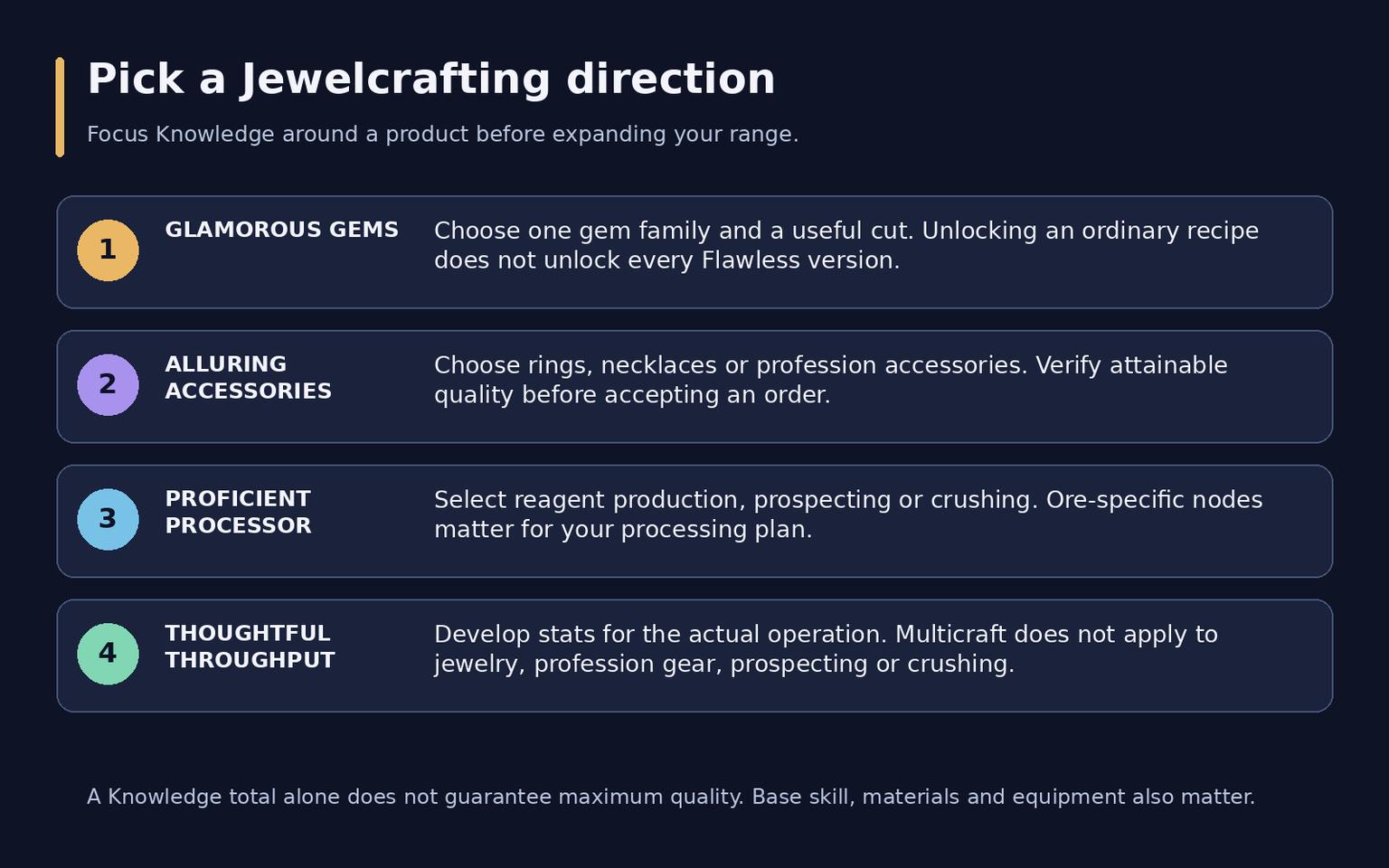
A jewelcrafter can develop every tree over time, but early Knowledge works better when it supports one chain. Unlocking a recipe, gaining skill for that product and improving production efficiency are distinct outcomes of your investment.
Tree | Main purpose | Initial choice |
Thoughtful Throughput | General crafting stats | Efficiency for the selected operation |
Glamorous Gems | Gemcutting and associated recipes | One family and desired cut |
Alluring Accessories | Rings, necklaces and profession accessories | One equipment category |
Proficient Processor | Reagents, prospecting and crushing | One processing or production chain |
Cutting gems
Start with a family whose finished gems and material costs you understand. Glamorous Gems develops individual cuts, with some Flawless recipes unlocked through Knowledge branches. Knowing the ordinary recipe does not automatically make its upgraded version available.
If additional output from eligible batch crafts is the priority, one opening is 5 Knowledge in Thoughtful Throughput and 30 in Outrageous Output. That is 35 points directed at general efficiency. Your chosen cut still needs development afterward. These points do not guarantee maximum quality or make a random Multicraft bonus occur on every craft.
Alternatively, prioritize skill for the selected product first. The decision depends on whether quality, recipe access or production cost is currently the main obstacle. Do not buy identical inputs for every cut without checking the journal.
Jewelry and profession accessories
Alluring Accessories separates rings, necklaces and profession equipment. One practical development target is the 30-point root plus 40 in the chosen branch, for 70 Knowledge total. This is a specialization plan rather than a standalone guarantee of maximum quality.
Resourcefulness is useful for expensive individual items. Rings, necklaces and profession equipment do not benefit from Multicraft. Before accepting an order, inspect the quality calculation using the actual reagents and your equipment, then agree on any Concentration expenditure.
Reagents for sale
The production side of Proficient Processor separates basic and optional reagents. Sunglass Vials, Sin'dorei Lenses and Kaleidoscopic Prisms have different uses. Select the recipes you want before developing their associated branch.
Do not base the calculation solely on the fact that other professions need a material. Compare your production cost with the finished item at the required rank. For vials, account for the vendor's available version: crafting your own only makes sense at an appropriate quality and price.
Prospecting and crushing
Prospecting Pro and Crushing Connoisseur both sit under Proficient Processor but improve different operations. If you work with one ore, check its specific node first. Copper Consumer, Tin-vestigator, Silver Scrapper and Thorium Thresher each relate to their own material.
Prospecting and crushing cannot Multicraft. Resourcefulness can save inputs, but a chance-based saving should not be treated as a guaranteed discount. Compare crushing with buying dust directly, and evaluate prospecting through the full output of several batches.
Quality, Concentration and equipment
Midnight reagents and consumables that use quality have two ranks, while crafted equipment retains five. The uncut Eversong Diamond is an exception among inputs because it has no quality rank. Its cut versions still need to be assessed through their own recipes.
Concentration helps compensate for missing skill where a recipe allows it. The supply regenerates over time and therefore limits production that depends on it. Ingenuity concerns Concentration refunds, Resourcefulness can save materials and Multicraft adds output where the recipe supports it.
A jewelcrafter uses one tool and two accessories. Fill the starter slots before committing to expensive upgrades.
Item | Crafted by | Equipment slot |
Farstrider Clampers | Engineer | Tool |
Apprentice Jeweler's Apron | Leatherworker | Accessory |
Silvermoon Loupes | Jewelcrafter | Accessory |
Choose stats for the operation: a tool for a gem batch can differ from one used for prospecting or a ring. Epic equipment supplies more secondary stats than rare equipment, but does not automatically provide a larger base skill bonus. Compare the actual stats and attainable product quality before buying.
One-time and recurring Knowledge
First crafts award bonuses marked in the journal. Eight profession treasures provide 3 Knowledge each, for 24 total. They are in Silvermoon City, Eversong Woods and Voidstorm, with each treasure collected once per character.
Skill Issue: Jewelcrafting grants 10 Knowledge and requires Midnight Jewelcrafting 25 plus renown 6 with the Silvermoon Court. Check the vendor's current purchase conditions first. Artisan Jewelcrafter's Moxie belongs to Jewelcrafting and should not be treated as a shared balance for every profession.
Source | Reward or schedule | Planning consideration |
Weekly crafting-order quest | Thalassian Jewelcrafter's Notebook: 3 Knowledge | Claim the reward after meeting the requirements |
Two weekly treasure items | 4 Knowledge in total | Separate these from the eight one-time finds |
Thalassian Treatise on Jewelcrafting | 1 Knowledge per week | Order from a scribe or send from your own character |
NPC Patron orders | Variable rewards | Check recipe access, quality and your own costs |
Darkmoon Faire | 3 Knowledge per monthly cycle | Exclude from a fixed weekly total |
If the quest is missing, check the introductory crafting questline. Catch-up orders support characters who are behind and are not an unlimited extra source after reaching the current allowance. A fixed Knowledge total from all orders cannot be guaranteed in advance.
Season 2 additions
New recipes refine Crystalline Glass and Duskshrouded Stone into higher-quality versions. One rank-two material requires 10 rank-one glass or 18 rank-one stone respectively. These conversions apply to those two reagents, rather than establishing a universal upgrade rule for every ore and gem.
Season 2 also adds Polished Ammolite and the Opalescent Amani Peridot, Piercing Amani Lapis and Roaring Amani Garnet decor items. Check recipe sources and unlock requirements before purchasing a design. This is not a complete decor catalog, and an embellishment's availability does not make it the best choice for every class.
Use current seasonal reagents and recrafting parameters for equipment. Do not transfer item levels from launch tables to a new order without checking them.
Evaluating processing and production costs
Begin with a small batch. Record the value of the ore or gems, the actual output of each material, quality and auction expenses. For prospecting, compare the combined value of several batches: a single lucky diamond can heavily distort a short sample.
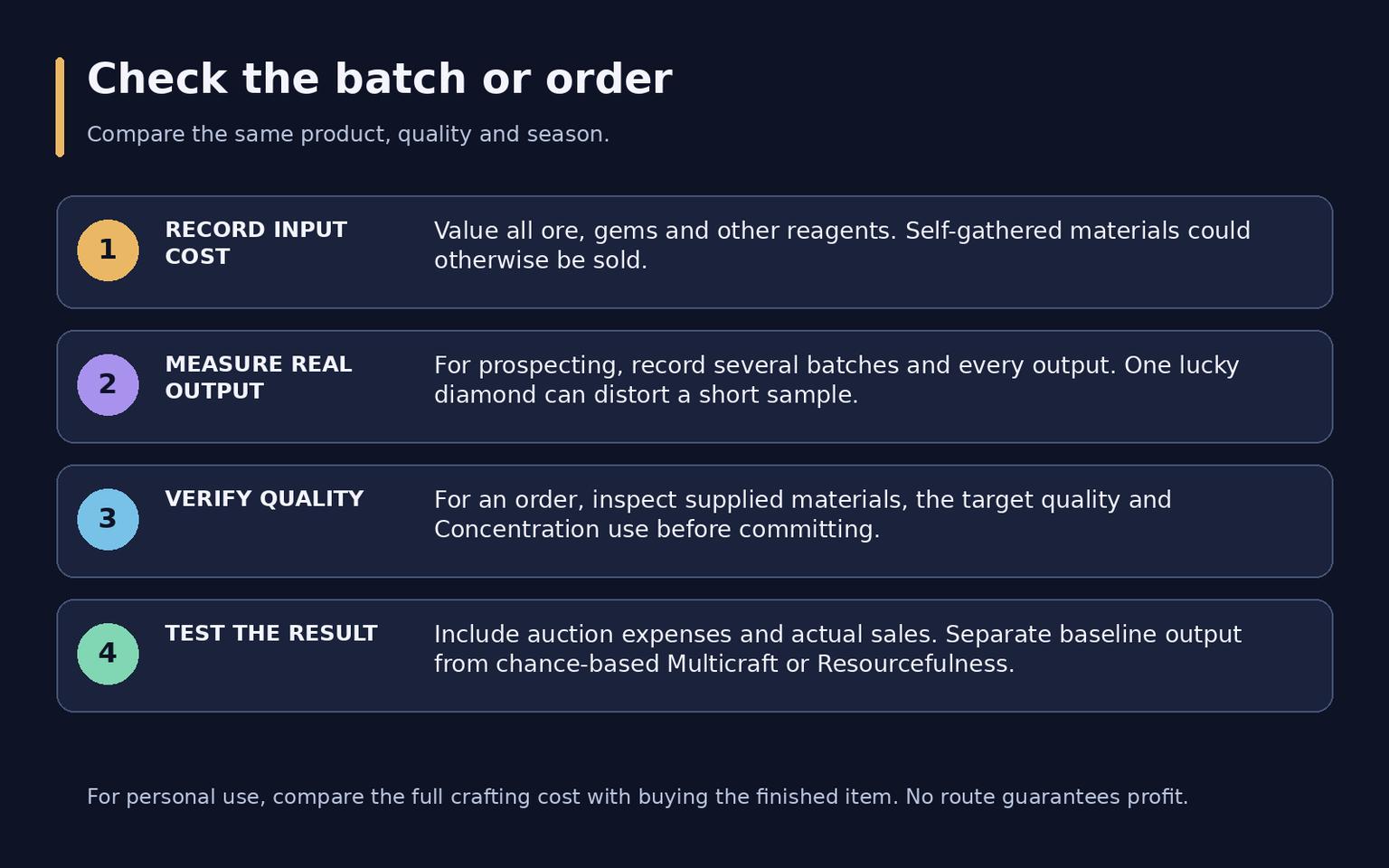
For gemcutting, separate output without random bonuses from the average with Multicraft. For an order, account for materials, Concentration and payment. Slow sales mean that increasing production ties up more gold in stock. For personal use, compare the complete crafting cost with buying the finished item.
Frequently asked questions
Is Mining required for Jewelcrafting?
No. It provides convenient supply, but you can buy ore, gems and dust. Compare the complete chain, including the value of self-gathered inputs.
Does every ore produce the same gems?
No. Gem families and rarity depend on the ore. Eversong Diamond chance is tied to relevant nodes and is not guaranteed for each batch.
Can one cheap recipe finish leveling?
Do not assume that beforehand. Past 65, compare available routes by recipe color, specialization and unlock cost.
What should I choose for gold making?
Start with products whose quality, costs and sales you can verify. Gemcutting, jewelry and processing have different constraints; no direction guarantees profit on its own.