WoW Midnight Mage Guide: Arcane, Fire and Frost
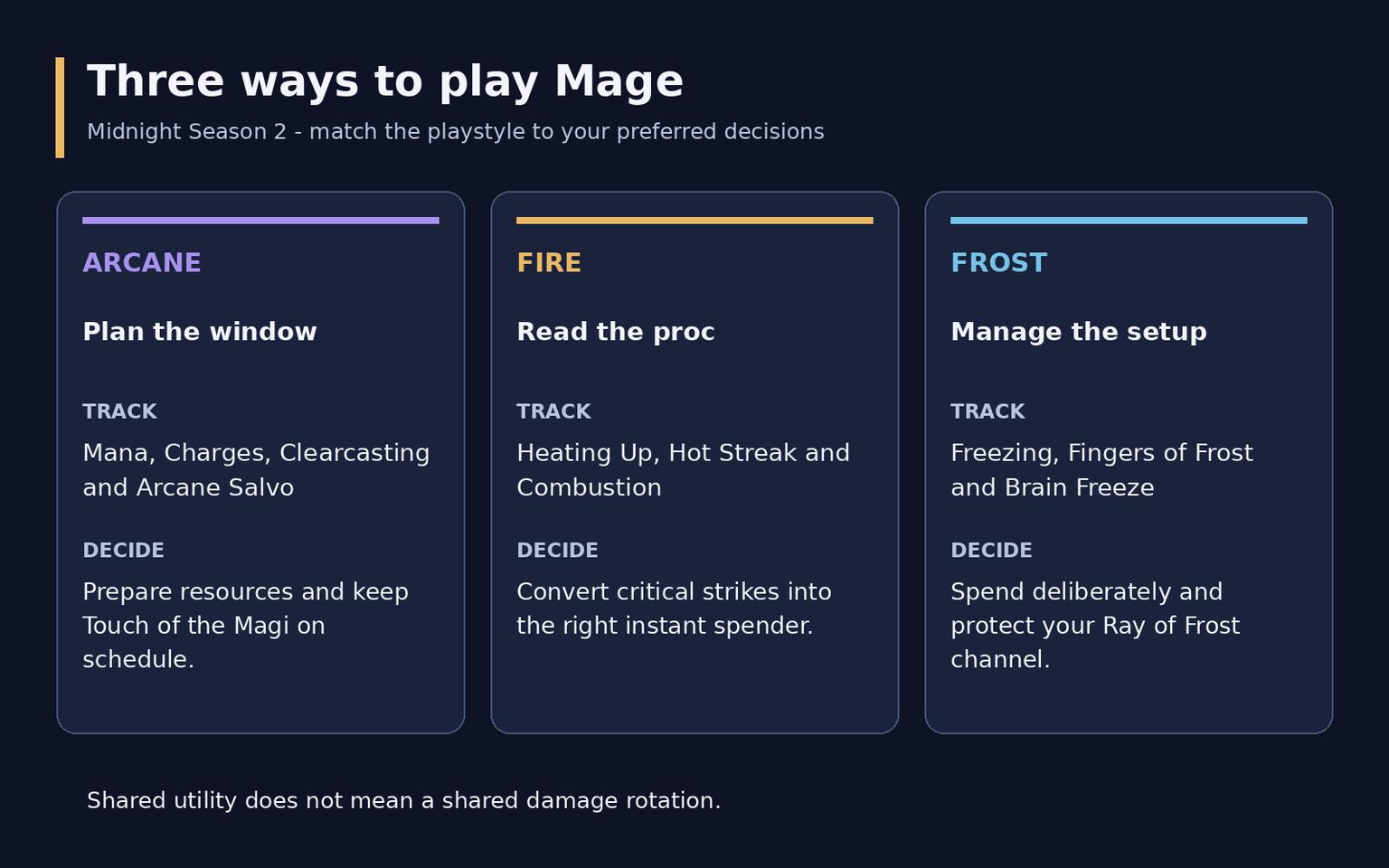
Mage offers three ways to deal ranged damage. Arcane connects powerful damage windows with mana, Arcane Charges and temporary buffs. Fire converts critical strikes into instant spells and makes the most of Combustion. Frost builds Freezing on enemies and uses procs to deliver strong ice attacks. Sharing a group role does not give the three specializations one rotation.
This guide was checked on October 15, 2026 for Midnight Season 2 and patch 12.1.5. It helps you choose a playstyle, understand the important decisions and prepare for raids, dungeons and quests. Exact priorities still need to match your Hero Talent tree, selected talents and set bonuses.
Specialization | Main objective | Important information to track |
Arcane | Prepare and execute damage windows | Mana, Charges, Clearcasting and Arcane Salvo |
Fire | Generate and spend Hot Streak | Critical-strike chains and Combustion |
Frost | Build Freezing and exploit procs | Fingers of Frost, Brain Freeze and Ray of Frost |
Frost is a comfortable questing introduction because slows help control distance. Fire suits players who enjoy rapid sequences of instant spells. Arcane rewards advance planning around resources and cooldowns. Avoid choosing solely on a promise that one specialization wins everywhere: the encounter and group determine which strengths are useful.
Changes that affect the current guide
Arcane received a new Season 2 Apex Talent built around Prismatic Bolt. Orb Mastery was redesigned and no longer spends Clearcasting through its previous interaction. Arcane Missiles therefore remains important, making an older sequence that repeatedly prioritizes orbs an unreliable teaching tool.
Fire's Season 2 tuning redistributed power between Combustion and ordinary spells. Damage outside the major cooldown remains part of the result. Idle time and wasted procs do not become harmless simply because Combustion is still recovering.
Patch 12.1.5 fixes Frost interactions involving projectiles, secondary targets and Hero Talents. Splinterstorm can now be tracked through the built-in Cooldown Manager, and its state no longer resets when a raid encounter or Mythic+ starts. Arcane's changes in this intermediate patch concern spell visibility for other players. A list of earlier PvP changes should not be presented as the complete PvE class update.
Match talents to the assignment
Identify the assignment first: a sustained boss fight, several durable targets or short packs. Then choose the appropriate specialization build and Hero Talent tree. Inspect defensive and utility talents separately, because another player's damage result does not show which tools your own party needs.
Specialization | Available Hero Talent trees | What changes |
Arcane | Sunfury / Spellslinger | Orb, Barrage and damage-window interactions |
Fire | Sunfury / Frostfire | Combustion preparation, filler spells and extra effects |
Frost | Frostfire / Spellslinger | Frostfire spells, Spike, Splinters and AoE interactions |
Current Icy Veins priorities recommend Sunfury for Arcane and Fire. Frost guidance distinguishes Spellslinger for single-target from Frostfire for AoE. These are current starting recommendations, rather than a permanent ban on another tree or a verdict for every encounter.
After importing a loadout, check the talents and action bars yourself. Some abilities replace others, and a set bonus can alter individual casting conditions. Combining instructions from two builds can produce an impossible priority: a stack threshold suitable for one Hero tree may not belong to the other.
Arcane: Charges, mana and cooldown windows
Read the resources separately
Arcane Charges and Arcane Salvo serve different purposes. Charges strengthen core spells, while Salvo helps prepare a powerful Arcane Barrage. Clearcasting enables useful Arcane Missiles casts. Watching mana alone can therefore miss the proc that determines your next action.
The ordinary loop builds Charges, uses available empowered spells and spends a prepared Barrage when the build's conditions are met. Do not reset Charges after every Arcane Blast out of habit. Conversely, repeatedly casting expensive spells at full Charges without watching mana can leave you unable to execute the next useful window.
Prismatic Bolt becomes available through the Apex interaction and restores a full set of Arcane Charges. Its casting priority can depend on the four-piece bonus and Cumulative Power. One stack requirement cannot cover every Mage. If you do not own the relevant set, do not wait for a buff your character cannot generate.
Arcane Surge and Touch of the Magi
Arcane Surge and Touch of the Magi establish the main cooldown pattern. The current basic plan also uses Touch between two Surges. Holding it every time for the next large window loses individual uses and shifts the rest of the encounter plan.
The opening combination of Arcane Barrage and Touch of the Magi accounts for projectile travel: Touch needs to apply before Barrage lands. Practice that interaction on a target dummy separately. Then work on following the normal priorities inside the cooldowns while remaining ready to move or defend yourself.
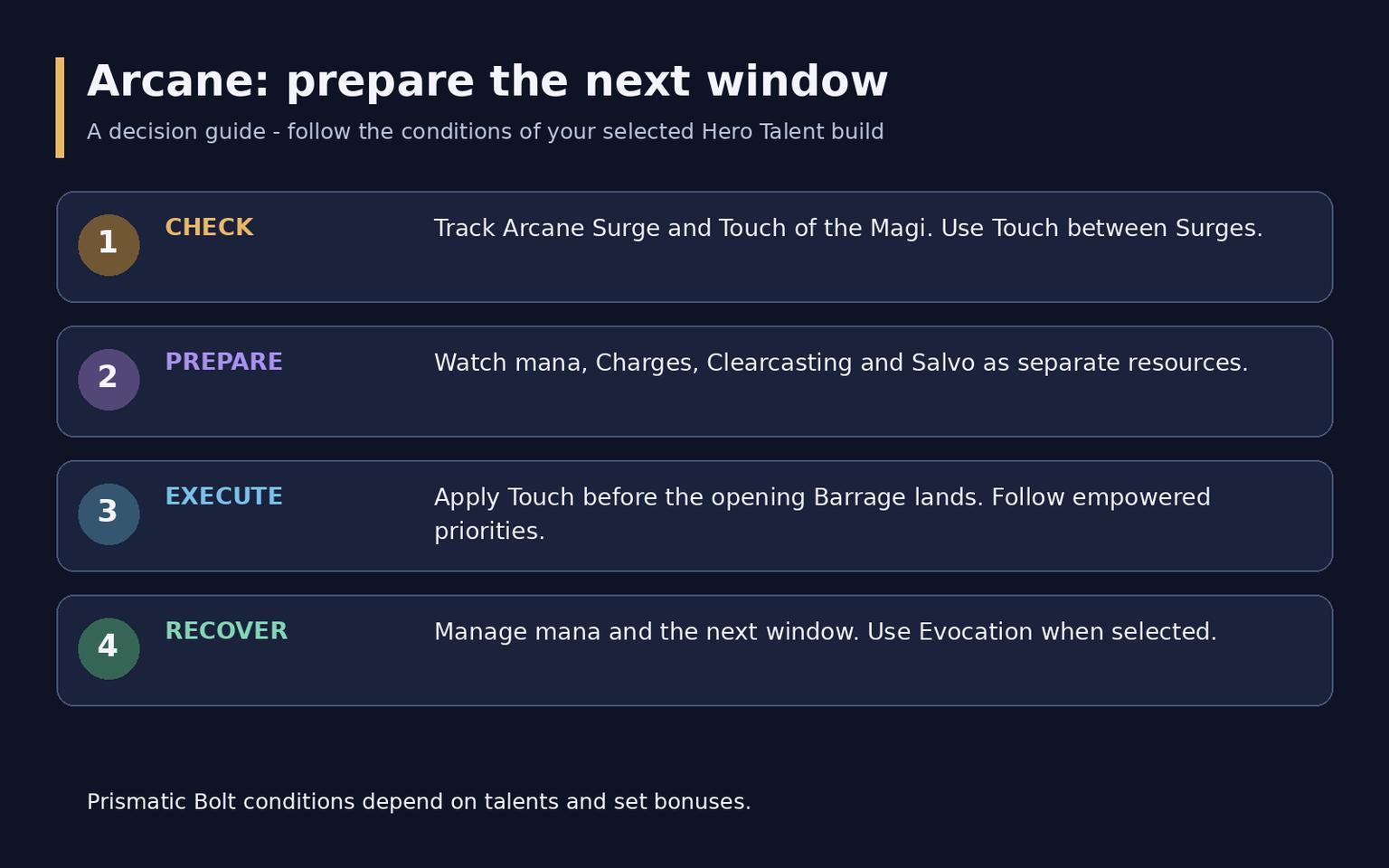
Arcane Surge also interacts with mana recovery. It is not simply a button reserved for a full mana bar. Evocation belongs in the plan when selected, rather than being an automatic requirement for every loadout. Consider the next mechanic before beginning an important channel or damage window so forced movement does not erase its value.
Fire: turn the proc into the right spell
Heating Up and Hot Streak
Critical strikes produce Heating Up and then Hot Streak. Fire Blast helps complete that sequence. Hot Streak enables a quick Pyroblast, or Flamestrike when the build and multi-target situation call for it. Read the proc state before pressing the next generator so you do not spend resources pointlessly after Hot Streak is already ready.
Fireball, or the appropriate Frostfire replacement, fills gaps between stronger actions. Do not hardcast Pyroblast merely because it looks stronger than the ordinary filler. Specific talents can justify a hardcast, but those conditions need to be distinguished from an instant Hot Streak spender.
Combustion and movement
Combustion guarantees critical strikes, supporting a dense chain of strong instant casts. Prepare a safe position, useful Fire Blast charges and compatible cooldowns. Avoid postponing the window indefinitely, while also avoiding a start immediately before the target becomes unavailable.
State | Main decision | Mistake to avoid |
Heating Up is active | Check how to complete Hot Streak | Spending generators without reading the existing proc |
Hot Streak is active | Use the appropriate instant spender | Holding the proc so long that new opportunities are wasted |
Combustion is approaching | Prepare resources and safe attacking time | Stopping all damage while waiting for perfection |
Scorch can support movement when talented. Its damage priority depends on the Hero tree, however: a Sunfury recommendation does not automatically apply to Frostfire or execute range. Shimmer can also preserve casts in suitable situations, but it does not remove the need to know where you will land.
Against several enemies, account for Ignite spread and the chosen Flamestrike conditions. Maximum total pack damage is not always more important than killing one dangerous opponent quickly. Follow the selected build instead of replacing every Pyroblast with a ground spell regardless of enemy positioning.
Frost: Freezing stacks and proc control
Understand the current loop
Frostbolt and other qualifying spells build Freezing on enemies. Ice Lance uses that mechanic for additional damage. Fingers of Frost provides a strong Lance effect without consuming the target's ordinary stack pool. A physical root is therefore not required for the modern damage mechanic; control state and damage setup are different systems.
Brain Freeze enables Flurry through a cooldown reset. Thermal Void changes the next Lance's interaction with Freezing. Track those states together so new procs are not wasted and Lance is not cast simply because it is available.
Glacial Spike and Comet Storm are linked to transformations of other buttons in the current system. Check which spell is actually available after the selected talents and preceding casts. Older advice to maintain all of them as permanently separate buttons is not an accurate introduction to today's Frost.
Ray of Frost and multiple targets
Ray of Frost is an important damage opportunity. Pick a position that allows you to channel without an avoidable interruption. If a lethal mechanic forces movement, survive first, then review whether an earlier start or different position could have protected the channel. Repeatedly losing it wastes a meaningful part of the toolkit.
Frozen Orb and Blizzard also need attention to enemy movement. An Orb missing the pack, or an area left behind after the tank moves, delivers less value. Do not rely on the old cycle of near-constant Orb availability through Blizzard cooldown reduction; that interaction does not describe Midnight.
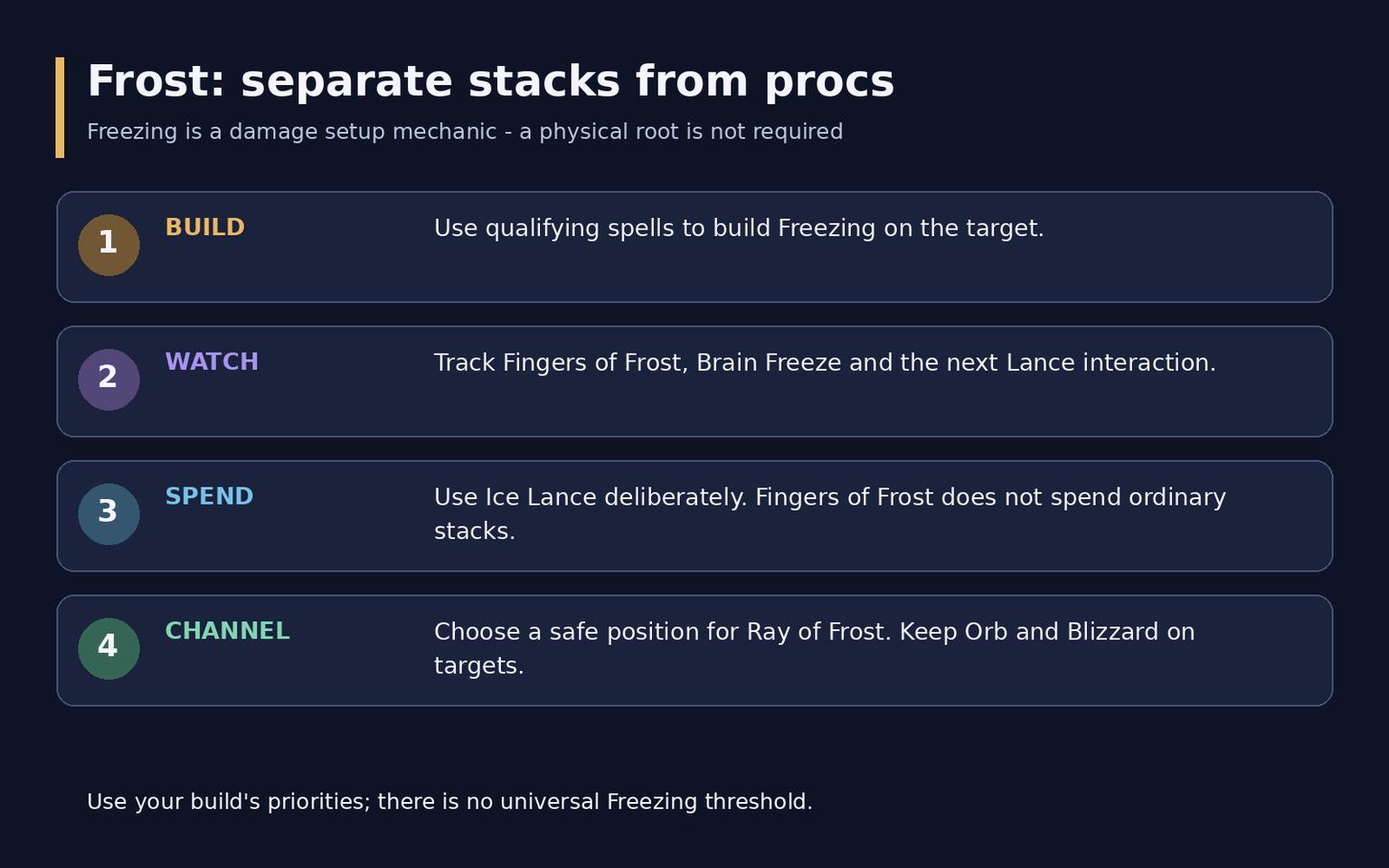
Multi-target play adds the talented interactions of Comet Storm, Spike and Frostfire effects. Avoid one fixed sequence or stack threshold for every build. When starting out, preventing lost Fingers of Frost and unused Ray opportunities is more useful than attempting every small optimization simultaneously.
Defensives and group utility
Mage gains a great deal from using protection before the dangerous hit. Check your Barrier and selected improvements: Season 2's improved Barriers grant another charge and a specialization-specific additional effect. That is a talent interaction, rather than identical free protection for every Mage without inspecting the tree.
Ice Block and its talented replacements require different decisions. Do not assign the original spell's full immunity to a replacement that works differently. Alter Time requires awareness of the saved health and return position; saving a bad location does not make it safe to revisit. Arcane's Refractive Images delays part of incoming damage, so the damage arriving afterward still needs attention.
Counterspell interrupts a qualifying enemy cast. Spellsteal handles a stealable beneficial magic effect, while Remove Curse serves a different purpose on an ally. Those tools are not interchangeable. Polymorph supports control, but damaging the controlled target can undermine the group plan.
Keep Arcane Intellect available to the group and agree on Time Warp timing before the pull. Use Blink or Shimmer with a known destination. Avoiding the mechanic while preserving attacking time is more useful than a random teleport that immediately requires another emergency adjustment.
Gear and secondary stats
Intellect improves spell power for all three specializations. Item level, useful weapons, trinkets and the required set-bonus threshold matter more than chasing a perfect secondary-stat order on every isolated piece. Rings and items with unusual effects deserve their own comparison.
Specialization | Icy Veins starting secondary-stat order | Qualification |
Arcane | Haste, Critical Strike, Mastery, Versatility | Secondary values are close; check your own distribution |
Fire | Haste, Mastery, Versatility, Critical Strike | Crit matters to the mechanic without necessarily being the best gear stat |
Frost | Mastery, Critical Strike, Haste, Versatility | The first three become closer in value as gear improves |
A Hero Talent name does not create one stat list across two specializations. Spellslinger Arcane and Spellslinger Frost do not automatically want identical equipment. Simulate the actual build and available items. Avoid breaking an important set bonus for a marginal secondary-stat improvement.
Separate a long-term crafting setup from the upgrade needed today. If your weapon is weak, Aln'hara Cane with Hunter's Ritual Stone may help more than waiting for an ideal drop. With a good one-handed weapon, Aln'hara Lantern can carry that embellishment instead. Arcanoweave Lining complements the setup on an appropriate cloth slot. Before ordering, compare cost, upgrade level and likely replacement.
Kith'ix drops add options without making every new trinket mandatory. Ascendant Venomstones unlock through the research chain during the week of October 20. On this guide's check date, they are a future progression step rather than an upgrade already available for today's gear.
Gems, enchants and consumables
Specialization | Default flask | Combat potion |
Arcane | Flask of the Blood Knights, checked against the full set | Light's Potential |
Fire | Flask of the Blood Knights | Light's Potential |
Frost | Flask of the Shattered Sun | Potion of Recklessness |
Current Arcane and Fire epic-gem guidance depends on socket count: Powerful Eversong Diamond with at least five sockets, and Indecipherable Eversong Diamond with fewer. The first setup also considers a spread of rare gem colors. This means choosing one epic gem, rather than equipping both simultaneously.
Frost guidance starts with Indecipherable Eversong Diamond and Flawless Masterful Garnet in remaining sockets. Do not transfer that recommendation to Fire simply because both wear cloth. Compare rare gem combinations with the complete character's stat distribution.
Fire weapon guidance recommends Acuity of the Ren'dorei, while Frost uses Jan'alai's Precision. Check Arcane's weapon enchant against its current set as well. Thalassian Phoenix Oil is the temporary weapon oil. Silvermoon Parade is a food starting point for Arcane and Fire; Frost also has other suitable food options. Bring a health potion and enough consumables for several attempts when preparing for demanding content.
Leveling, race and professions
Frost is comfortable for most new characters because slows help keep enemies away. Arcane can be particularly effective with strong starting gear. Fire needs the talents that make its interactions work, so its early-level feel does not describe the maximum-level specialization.
Learn the procs while leveling instead of ignoring them. They will determine valuable actions later as well. Increase pull size gradually, checking control, protection and safe casting space. Recovering between fights and using conjured food helps prepare for the next group without unnecessary risk.
Race and profession choices do not replace specialization knowledge. Pick a race for useful abilities and personal preference. Tailoring, Enchanting, Alchemy and gathering serve different economic interests; there is no compulsory pairing for every Mage. Crafting orders let you obtain crafted gear without learning the relevant profession yourself.
Interface and preparation habits
Place information that changes your next action near your attention area. Arcane needs mana, Charges and buffs. Fire needs Heating Up, Hot Streak and Fire Blast charges. Frost needs Freezing, Fingers of Frost, Brain Freeze and Ray availability. Track defensives and Counterspell separately from the main damage indicators.
Mouseover or focus macros can simplify control targeting. Hostile-target conditions for Spellsteal do not suit a friendly Remove Curse action. Check spell language and valid living-target conditions. A single macro press does not execute several ordinary global-cooldown spells for you.
Before starting, check the loadout, Barrier, food, group buff and movement plan. After a mistake, identify the cause: a lost channel, wasted proc, late defensive or unavailable target during the cooldown. Change one observable habit at a time so the result can be evaluated.
Frequently asked questions
Which specialization should a first Mage try
Frost is usually a comfortable starting point for solo leveling. At maximum level, choose for the playstyle and activity rather than one universal ranking.
Should Fire stack as much Critical Strike as possible
No. Crit is part of the mechanic, but Combustion and other interactions change its value on equipment. Compare the actual gear options.
Is there a shared rotation for all three specializations
No. They share some defensive, movement and group tools, while offensive priorities depend on specialization, Hero Talents and the selected build.