WoW Midnight Rogue Guide: Assassination, Outlaw and Subtlety
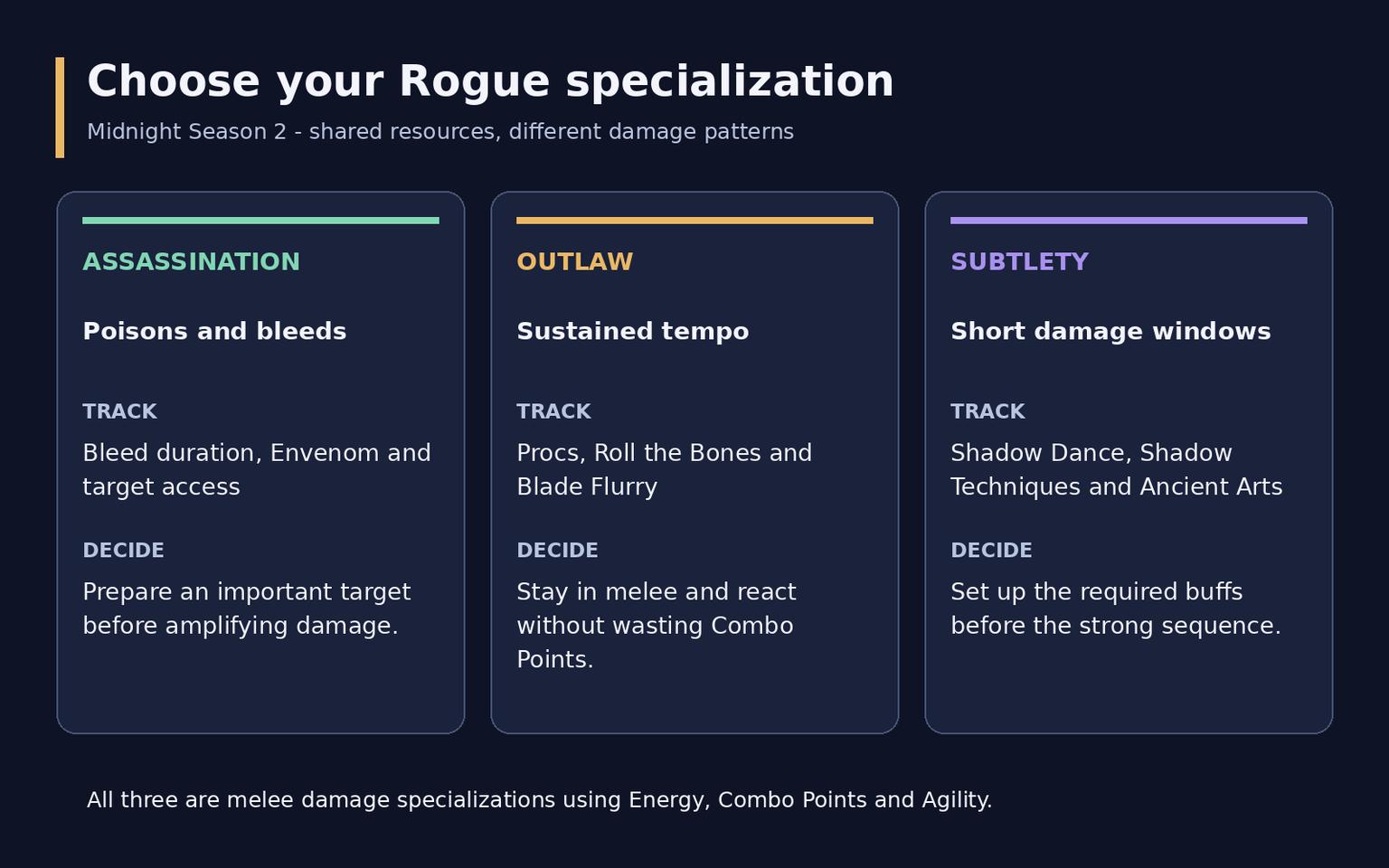
Rogue in WoW Midnight is a melee damage class built around Energy, Combo Points and tools for controlling enemies. Assassination develops damage through poisons and bleeds, Outlaw maintains a rapid stream of attacks, and Subtlety prepares short periods of concentrated damage. Choose the decisions you enjoy making rather than expecting one specialization to lead in every activity.
This guide was checked on October 15, 2026 for Season 2 and patch 12.1.5. It explains the foundations of all three specializations, talents, survival and preparation for dungeons and raids. The priorities describe how the mechanics connect; they do not replace a complete build for a particular encounter and equipment set.
Specialization | Main damage pattern | Main demand |
Assassination | Poisons and bleeds, amplified on important targets | Effect duration and cooldown preparation |
Outlaw | Rapid direct attacks and nearby-target damage | Procs, Roll the Bones and melee access |
Subtlety | Short powerful sequences during Shadow Dance | Buff preparation and precise execution |
All three wear leather and use Agility. When changing specialization, inspect ability weapon requirements before reviewing trinkets and set bonuses. Outlaw's pistol is part of its abilities, not a separate ranged weapon slot that needs an auction-house purchase.
Assassination suits a more measured approach to tracking target effects. Outlaw rewards players who enjoy a fast pace and frequent reactions to opportunities. Subtlety appeals through preparing and executing strong sequences. Each punishes a different mistake: missing bleeds, prolonged melee downtime or starting Shadow Dance without its required setup.
Energy and Combo Points
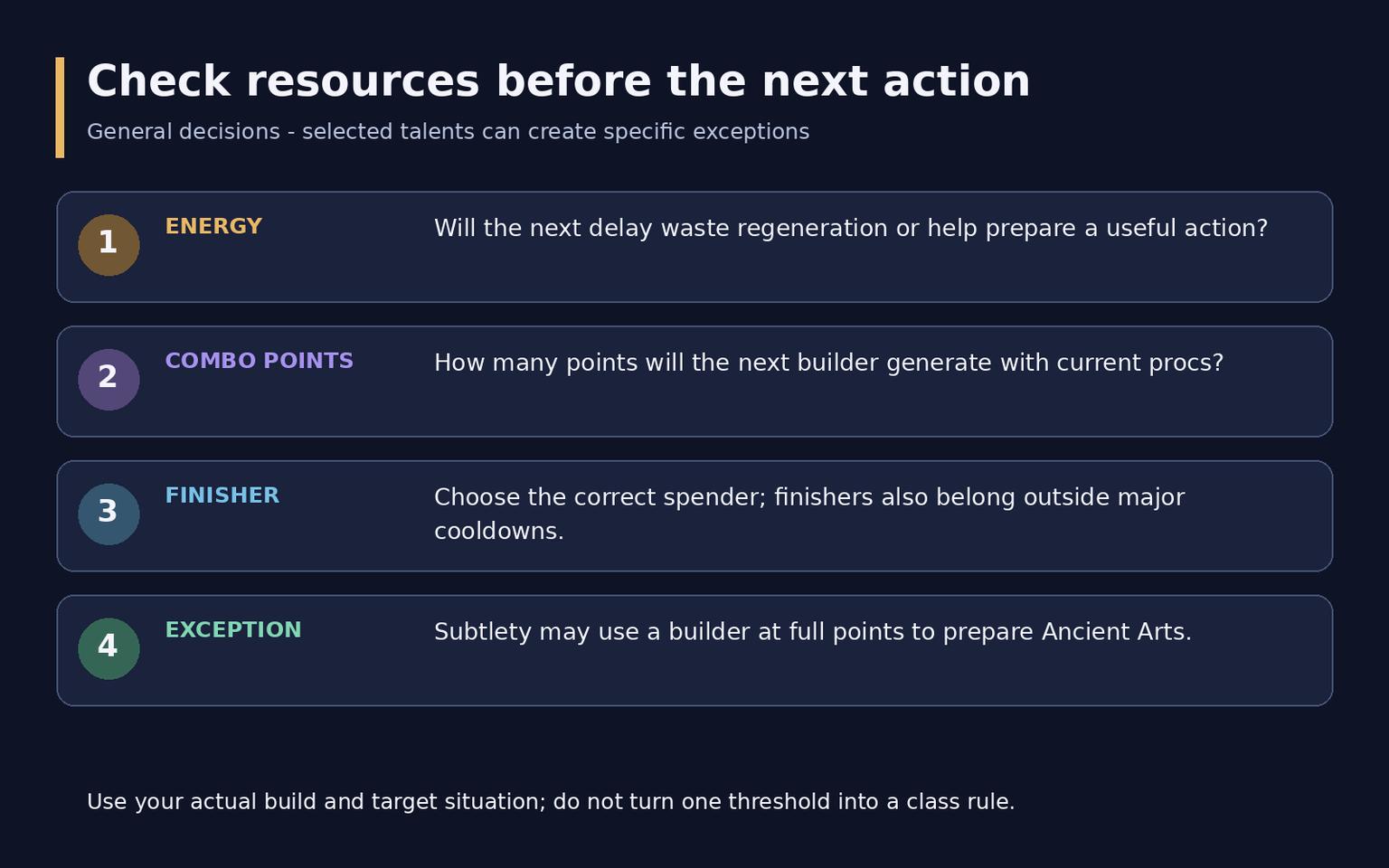
Energy limits how frequently you can act. Appropriate attacks generate Combo Points, and finishers spend those points for damage or other effects. Your maximum and preferred spending threshold depend on specialization and talents. A single rule about always spending at five points cannot describe the whole class.
Avoid unnecessary Energy capping and generating more Combo Points into a full bar. However, specific interactions can justify exceptions. Subtlety can deliberately use a generator at full points to prepare Ancient Arts. Understand what the action achieves instead of judging it only by the state of the resource display.
Finishers belong outside major cooldowns as well. Holding every finisher until the next large damage window disrupts the normal cycle and can interfere with cooldown recovery. Brief preparation is useful when it makes the upcoming sequence work; indefinite waiting is not a resource plan.
Current state | Inspect | Response |
Combo Points nearly full | How many the next attack generates | Avoid losing additional points without a benefit |
Low Energy | Upcoming mechanics and available effects | Accept a natural pause or prepare recovery |
Damage window approaching | Resources, buffs and target access | Establish the required conditions in advance |
Enemy almost dead | Remaining effect duration | Avoid lengthy setup on a disappearing target |
Keep Energy, Combo Points and important procs near the central part of your interface. This makes it easier to see the battlefield while deciding the next action. Repeatedly looking toward the screen edge makes even a straightforward priority harder during movement.
Talents and patch 12.1.5
Choose class talents around defense, movement and the control your group needs. The specialization tree defines offensive relationships, while Hero Talents add their own mechanics. Save separate builds for raids, Mythic+ and solo content. After an import, inspect the selected abilities and action bars.
Specialization | Hero Talents | Apex talents |
Assassination | Deathstalker / Fatebound | Implacable |
Outlaw | Fatebound / Trickster | Gravedigger |
Subtlety | Deathstalker / Trickster | Ancient Arts |
Apex talents belong to their specialization. Gravedigger is not a general option for every Rogue, and Fatebound's coin system does not replace Deathstalker's mark management. Switching Hero trees means checking target selection and finisher preparation again, even when much of the action bar remains familiar.
Patch 12.1.5 changes Deft Maneuvers: its additional Blade Flurry Energy cost is now five per target hit, capped at 30, instead of a flat additional 30. These numbers describe the talent's extra cost, not Blade Flurry's entire cost. The change makes use against small groups less expensive.
Subtlety's Shadow damage modifiers were corrected, including cases where the same bonus could apply more than once. Ability damage was simultaneously increased by 14% as compensation. That does not establish a straightforward 14% increase to the specialization's final damage. Some visual effects, including Shadow Blades, were updated too.
Avoid rebuilding today's priority from old expansion summaries. For example, losing the talent Crackshot does not mean losing Between the Eyes itself. Use the current specialization mechanics and selected build when deciding which abilities still matter.
Assassination and damage preparation
Maintain Garrote and Rupture on important targets, using appropriate generators such as Mutilate. Envenom handles much of your routine finishing. Its short buff matters as well: consecutive casts should connect usefully, without refreshing unnecessarily early or allowing avoidable gaps.
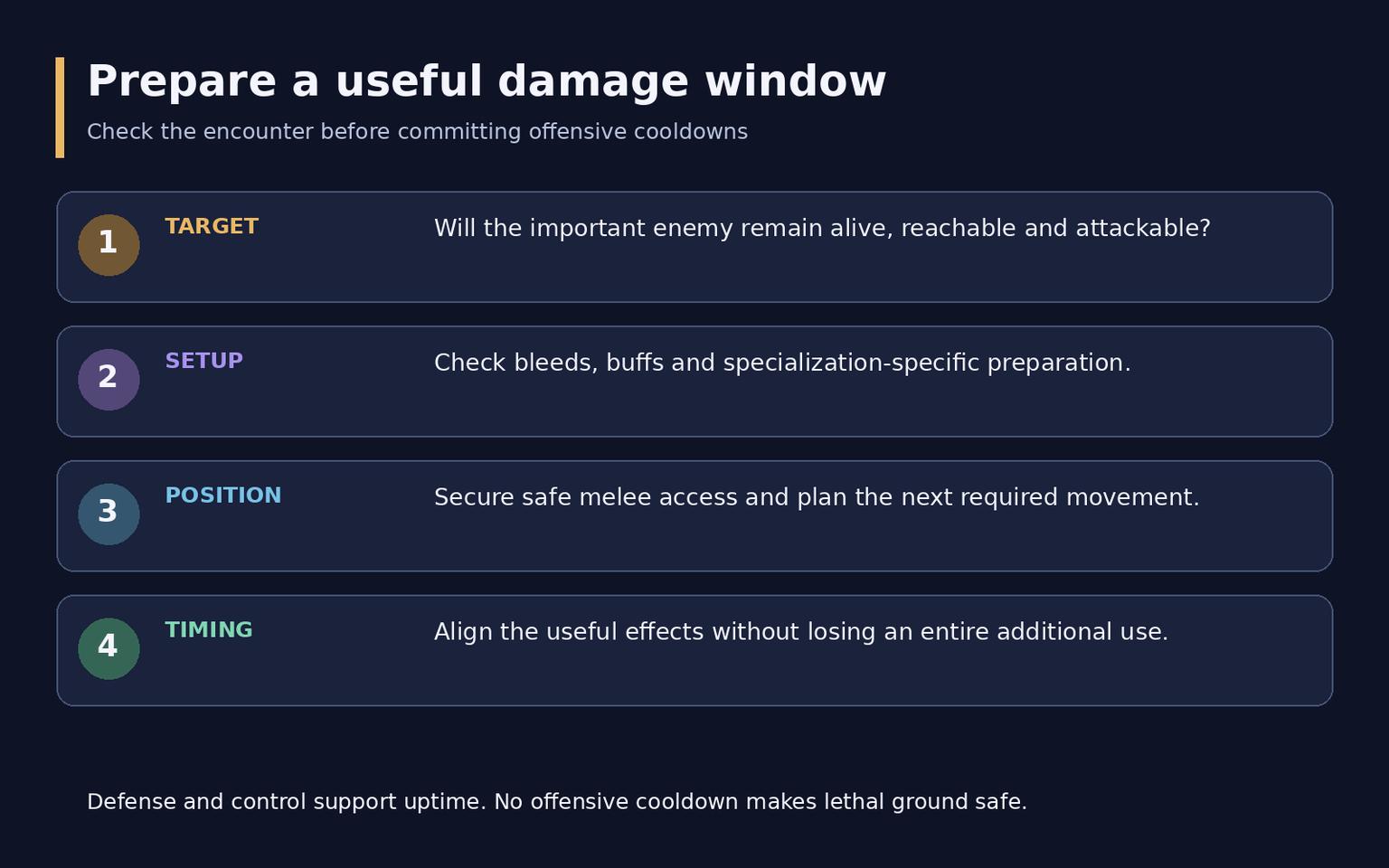
Deathmark and Kingsbane need a target that remains available long enough to benefit. Prepare the important effects and inspect incoming mechanics before starting. An immediate forced exit from melee wastes the opportunity. A short delay can help when it does not remove a complete additional use over the encounter.
For several enemies, account for bleed spreading. Current builds use Crimson Tempest to help spread bleeds and generate points, with Fan of Knives used according to the priority. Do not repeat the same manual setup on every weak enemy when your selected talents already solve that task.
With Deathstalker, track Deathstalker's Mark and Darkest Night separately from ordinary bleeds. An empowerment prepared on the previous target does not guarantee that your sequence continues correctly after a switch. Fatebound changes that part of the workload, but poisons, bleeds and normal resource cycling still need attention.
Outlaw and sustained tempo
Sinister Strike and Pistol Shot opportunities generate points. Between the Eyes and Dispatch spend them according to the current priority. Inspect procs before pressing another builder: an empowered attack can generate more points than expected, quickly turning a nearly full bar into resource waste.
Roll the Bones requires awareness of the current buff state. Reusing it whenever possible without inspecting that state can discard useful value. Adrenaline Rush and talented Preparation interact with tempo and cooldown recovery. Learn to recognize their availability first, then apply your build's detailed reset and extension conditions.
Activate Blade Flurry for suitable additional targets and position yourself so nearby enemies actually enter its coverage. Attacking an isolated enemy at the edge does not automatically produce effective group damage. Follow the tank's repositioning while remaining clear of dangerous ground.
Target access also matters because Restless Blades links normal finishing to cooldown recovery. Extended downtime costs both current attacks and future opportunities. Consistent execution therefore matters more than trying to hold the entire kit for one dramatic moment.
Subtlety and Shadow Dance
Shadow Dance enables stealth attacks. Shadowstrike, Secret Technique, Eviscerate and Shadow Blades form important relationships, but their order depends on talents and active buffs. Before entering a window, inspect the abilities you need and the movement the encounter is about to demand.
Ancient Arts interacts with Shadow Techniques and finisher preparation. An extra builder at full Combo Points can therefore be deliberate setup. Learn why your specific Hero build needs it instead of applying that exception throughout the fight or to another specialization.
Against multiple enemies, Shuriken Storm generates points and Black Powder provides an area finisher. Priority-target damage and total damage across the pack can call for different choices. Follow the encounter assignment rather than judging every decision by the total on a meter.
Natural Energy pauses outside Shadow Dance are acceptable. They do not automatically mean your gear needs replacing so that every global can be filled. Improve the quality of your powerful sequences first: preparation, minimal unnecessary delay and safe positioning provide clearer areas to work on.
Control and survival
Match defense to the threat. Feint primarily answers area damage, Cloak of Shadows helps against appropriate magical effects, and Evasion concerns dodging attacks. Talents can expand these tools, but none should be treated as unconditional immunity to every encounter mechanic.
Task | Tool | Check first |
Interrupt a spell | Kick | Assigned target and interrupt order |
Stop a susceptible enemy | Kidney Shot / Blind | Control immunity and damage breaking the effect |
Survive an incoming mechanic | Feint / Cloak of Shadows / Evasion | Damage type and selected talents |
Recover personal health | Crimson Vial | Whether a stronger emergency response is needed |
Bypass an enemy group | Shroud of Concealment | Route, detection and group coordination |
Stealth and Vanish create tactical opportunities, but do not guarantee bypassing every enemy or resetting any mechanic. Vanish also supports offensive interactions. Spending it automatically as spare defense can interfere with a build that needs it for the next setup.
Coordinate interrupts and control. If the enemy cannot be stunned, an unsuitable stop leaves its dangerous cast unanswered. When using Sprint, Shadowstep or Grappling Hook, inspect the destination as well as the immediate need to move. A mobility button is useful only when the resulting position is safe.
Equipment and preparation
Agility matters to all three specializations, but one secondary-stat order based only on the Hero tree name is inadequate. Assassination evaluates Critical Strike and Haste, Outlaw needs their balance, and Subtlety values Mastery with sufficient Haste for its build. Exact weights change with equipment and talents.
Upgrade | Compare | Practical purpose |
Weapon | Type, main-hand role and simulation result | Preserve ability functionality and improve damage |
Set piece | Bonuses and the rest of the loadout | Retain a useful combination rather than chase one stat |
Trinket | Effect and practical activation | Gain value in the actual encounter |
Crafted item | Weak slot, embellishment and price | Solve a specific equipment need |
Simulate complete loadouts for your character. Forest Hunter's Armor Kit is a leg enhancement; select weapon enchants, ring enchants and gems separately. Thalassian Phoenix Oil appears among weapon preparation options. It does not replace checking applied poisons before combat.
Assassination can choose Flask of the Blood Knights or Flask of the Shattered Sun according to existing Haste. Outlaw's Critical Strike and Haste balance also affects its flask. Subtlety can use Flask of the Blood Knights when it lacks the required Haste, then Flask of the Magisters once that need is met.
Light's Potential is a straightforward combat potion for Assassination and Subtlety. Current Outlaw guidance recommends Potion of Recklessness; Subtlety also considers it in area-damage builds when it grants Mastery. Carry Concentrated Silvermoon Health Potion for emergencies and food that supports Agility. Check the actual build rather than buying one preparation set for all three specializations.
Getting started and common questions
Outlaw is a reasonable solo-leveling starting point if you enjoy its pace, but it is not mandatory. Learn resources and defense before adding complex interactions. Choose professions around costs and interests: Leatherworking is convenient for making your own armor, without creating a compulsory profession pair for every Rogue.
Should you change race
Evaluate the particular racial ability against your content. Before paying for a change, fix missed actions, melee downtime and unused defense. A universal race ranking cannot replace addressing those practical problems.
Can macros help
A target-selection macro for Kick or a cursor-based Grappling Hook can simplify input. Test the behavior somewhere safe first. A macro cannot recognize the dangerous enemy or choose the correct timing for you.
Does the same build work in PvP
Choose talents, control and defenses specifically for arenas and battlegrounds. Energy and Combo Point fundamentals remain relevant, but a PvE priority and strong boss performance do not establish equal effectiveness against players.