WoW Race to World First: Midnight Results and Viewer Guide
Liquid won the Race to World First in The Venomous Abyss during Midnight Season 2. The guild defeated Mythic Ula'tek first on September 3, 2026. Echo followed about 25 minutes later, and Method finished third on September 4. These are completed results, rather than predictions made before the raid opened.
The Race to World First, or RWF, is about more than the final kill. Teams must decide when to gather equipment, when to keep pulling and which part of a failing strategy to change. This guide brings together the confirmed results, the release schedule and a practical way to understand the broadcast. Information was checked on October 16, 2026.
Place | Guild | Ula'tek defeated, UTC |
1 | Liquid | September 3, 19:04 |
2 | Echo | September 3, 19:29 |
3 | Method | September 4, 14:21 |
The timestamps use Raider.IO's boss rankings and a single time zone, UTC. In Moscow time, add three hours: the first two kills occurred at 22:04 and 22:29 on September 3, and the third at 17:21 on September 4. An article's publication time is not necessarily the time the boss died.
The victory was Liquid's fifth consecutive RWF title. Wowhead's report records a 17-day race and 306 pulls on the final encounter. That does not mean one team fought continuously for 17 days. The event included gearing runs, rest and reclearing after weekly resets.
What the Race to World First actually measures
The objective is to complete a new raid on Mythic difficulty before any other guild. Teams compete on live game servers, with confirmed kills establishing progression rather than an elimination bracket. Organizations run their own broadcasts, casters explain developments and specialist services track results. Blizzard opens the content, deploys changes and directs viewers toward community coverage.
An individual boss World First and the overall race victory are different accomplishments. A team can defeat an opening encounter while the eventual frontrunners are still collecting gear. That does not guarantee a first-place finish on the final boss. A table of individual first kills therefore cannot stand in for the raid's final standings.
The Venomous Abyss contains eight bosses, ending with Ula'tek. The separate Tidebound Grotto Lair also offers Mythic difficulty, but it is not a ninth encounter in this raid and does not determine the main race's winner. Clearing it can contribute equipment without changing what counts as completing The Venomous Abyss.
When the race took place
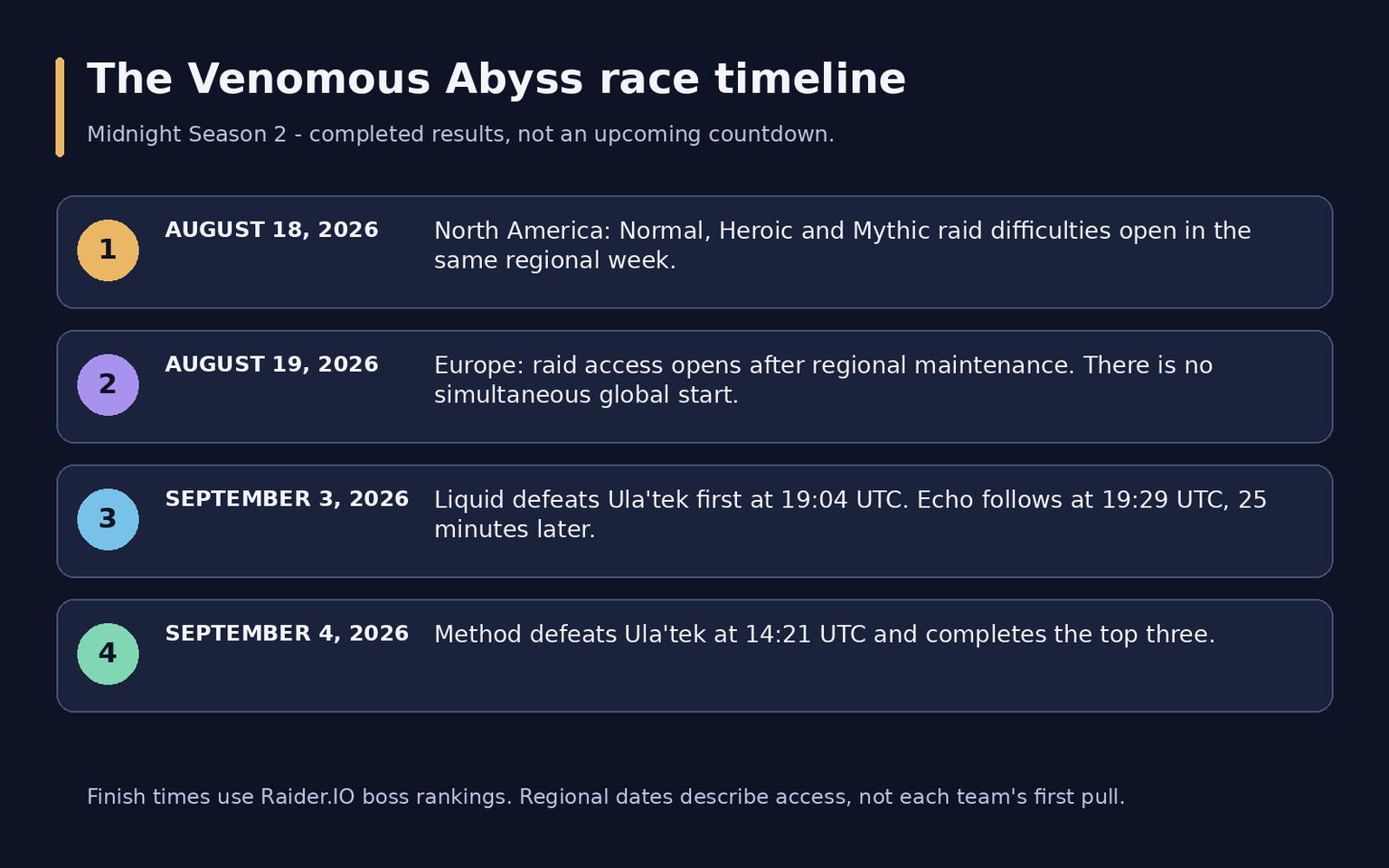
Normal, Heroic and Mythic versions of The Venomous Abyss opened in the same regional week. There was no separate Heroic-only week before Mythic became available. Regional maintenance still happened at different times, so access was not a simultaneous global launch.
Date in 2026 | Milestone | Why it matters |
August 18 | North American raid opening | Access opened; favorites did not have to begin Mythic pulls immediately |
August 19 | European raid opening | European teams entered after their own maintenance |
September 3 | Liquid and Echo defeated Ula'tek | First and second were separated by 25 minutes |
September 4 | Method defeated Ula'tek | The top three were established |
Raid Finder wings opened on a staggered schedule, but those dates were not the RWF schedule. Do not use the last Raid Finder wing's availability as the date the Mythic finale became accessible. Similarly, a content update arriving and a guild beginning serious progression are separate moments.
Making sense of regional access
Standings normally report the actual order of kills in global time. Simply subtracting the difference between regional openings and declaring another winner does not recreate a simultaneous race. Teams gained equipment and information in different sequences, encountered tuning changes at different points and chose their own daily schedules.
Separate two questions: who finished first in real time, and how regional access affected the conditions. The first establishes the recorded result. The second calls for analysis beyond recalculating a single row in a leaderboard.
Which guild earned each boss World First?
Several teams claimed individual first kills. The row order below makes the list easy to follow; it is not a mandatory route through the raid.
Encounter | First guild | What the result represents |
Nek'zali the Soulcoiler | Consequence | The opening boss World First |
Entombed Sentinels | Liquid | An individual mid-raid victory |
The Lost Explorers | xD | A first kill by another competing team |
Vashnik the Malignant | Method | One of Method's early successes |
Sszorak | Method | Another individual Method World First |
The Twin Fangs | Echo | An individual Echo victory |
The Coiled Altar | Liquid | The breakthrough into the final stretch |
Ula'tek | Liquid | The overall race victory |
The list explains why the event should not be reduced to its three most familiar organizations. Consequence and xD earned their own first kills, while leading guilds exchanged positions later in the raid. Liquid, Echo and Method's final places do not mean they occupied those same positions every morning.
The penultimate encounter, The Coiled Altar, was a substantial obstacle: Wowhead reported Liquid's first kill after 310 pulls. Ula'tek then required a separate learning process. A larger pull count does not automatically mean worse play. It may include early experiments and attempts made before tuning changes.
The work behind the broadcast
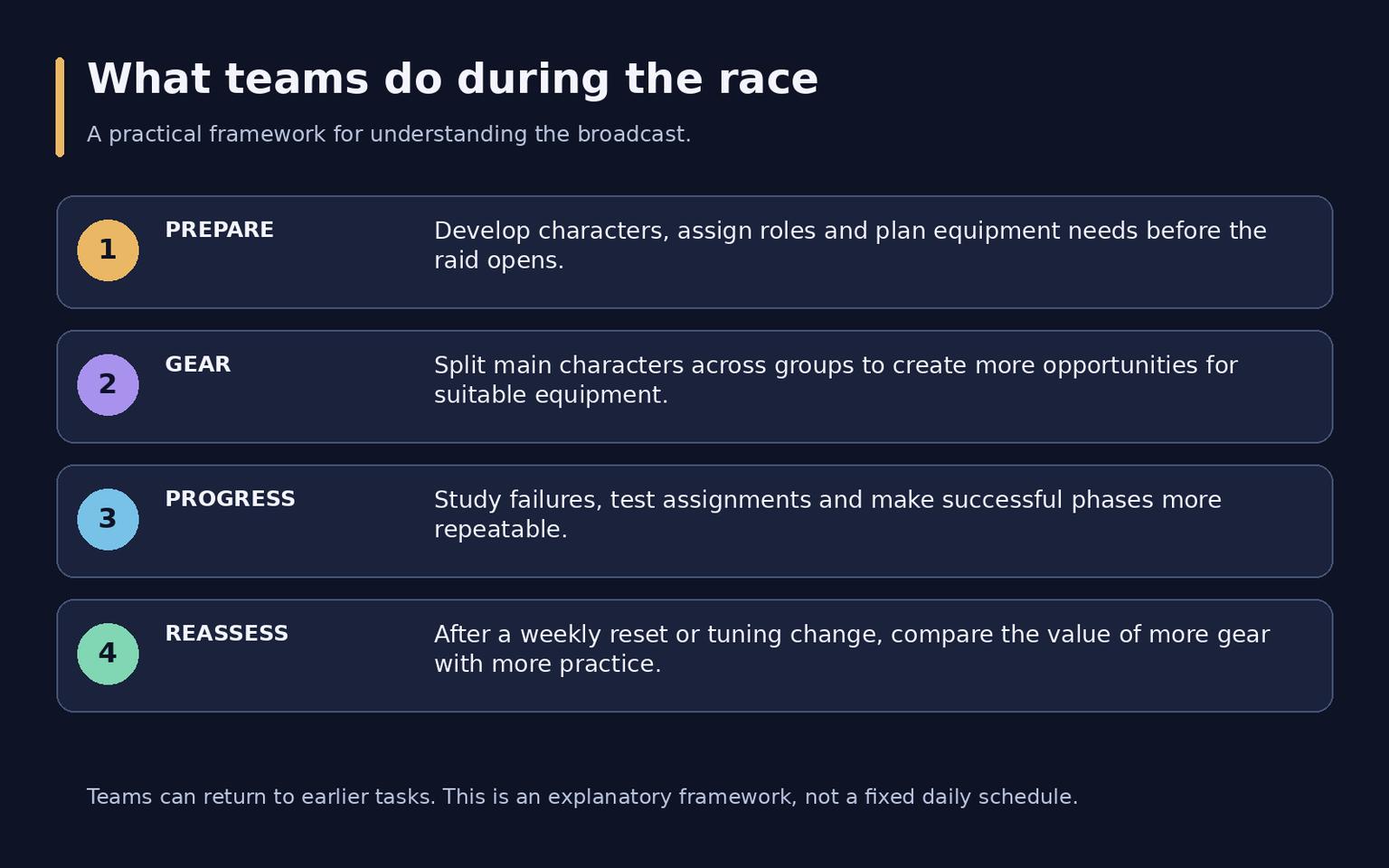
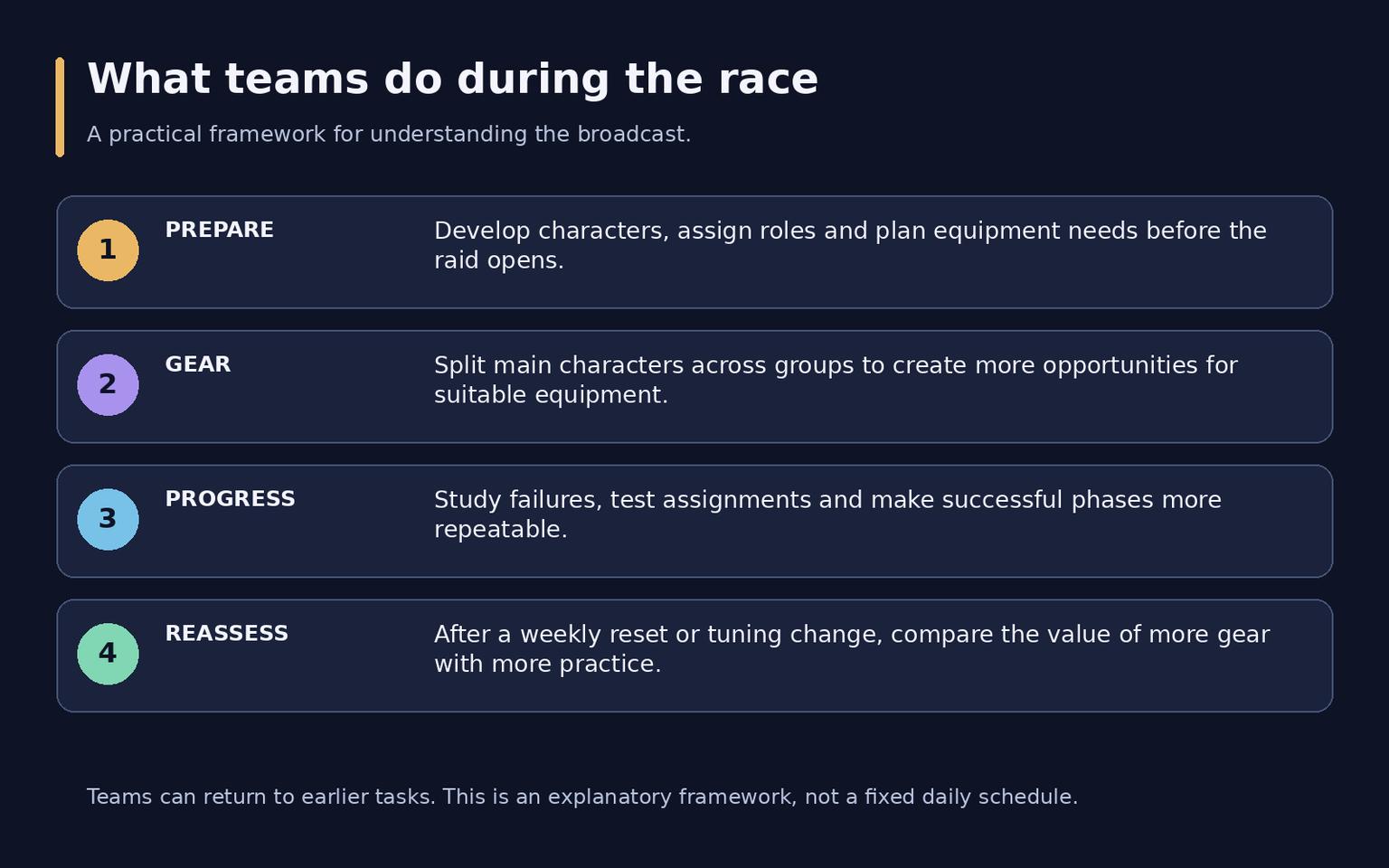
A broadcast shows only part of a team's decision-making. Before the raid opens, guilds develop characters, assign roles, prepare composition alternatives and plan equipment acquisition. Once live encounters reveal their actual difficulty, those plans can change. There is no universal rule that a leading guild should always enter Mythic first.
Stage | Team objective | What to watch |
Preparation | Characters, resources, roster and assignments | The intended plan and available substitutions |
Gearing | Strengthening important characters | Repeated Normal and Heroic clears |
Progression | Learning mechanics and coordinating execution | Death causes, phase transitions and strategy changes |
Weekly return | Choosing reclears versus fresh progression | Whether extra gear can repay the time spent earning it |
Why teams run splits
Split runs distribute main characters across several groups filled out by alternate characters and helpers. The aim is to create more opportunities for suitable equipment to reach key raiders. These runs serve an equipment plan; they are not repeated attempts to claim another leaderboard position.
Gearing has an opportunity cost. Each hour spent collecting items is an hour not spent learning a new Mythic encounter. Teams weigh that lost practice against the possibility that greater damage or healing will remove a major barrier. The opening days of The Venomous Abyss included substantial gearing work, so a quiet Mythic scoreboard did not mean a guild had stopped competing.
How tuning changes the comparison
An encounter can change while the race is underway. Coverage on September 2 recorded reductions to Ula'tek's second-phase difficulty. A best attempt before such a change and a new attempt afterward did not occur under identical conditions. Check when a change happened and whether both teams have tested the revised encounter before comparing their pace.
That does not turn every result into luck. Tuning alters the conditions, while execution, strategy and consistency remain the players' responsibility. A timing coincidence alone cannot explain the entire outcome of the race.
Reading a progression board
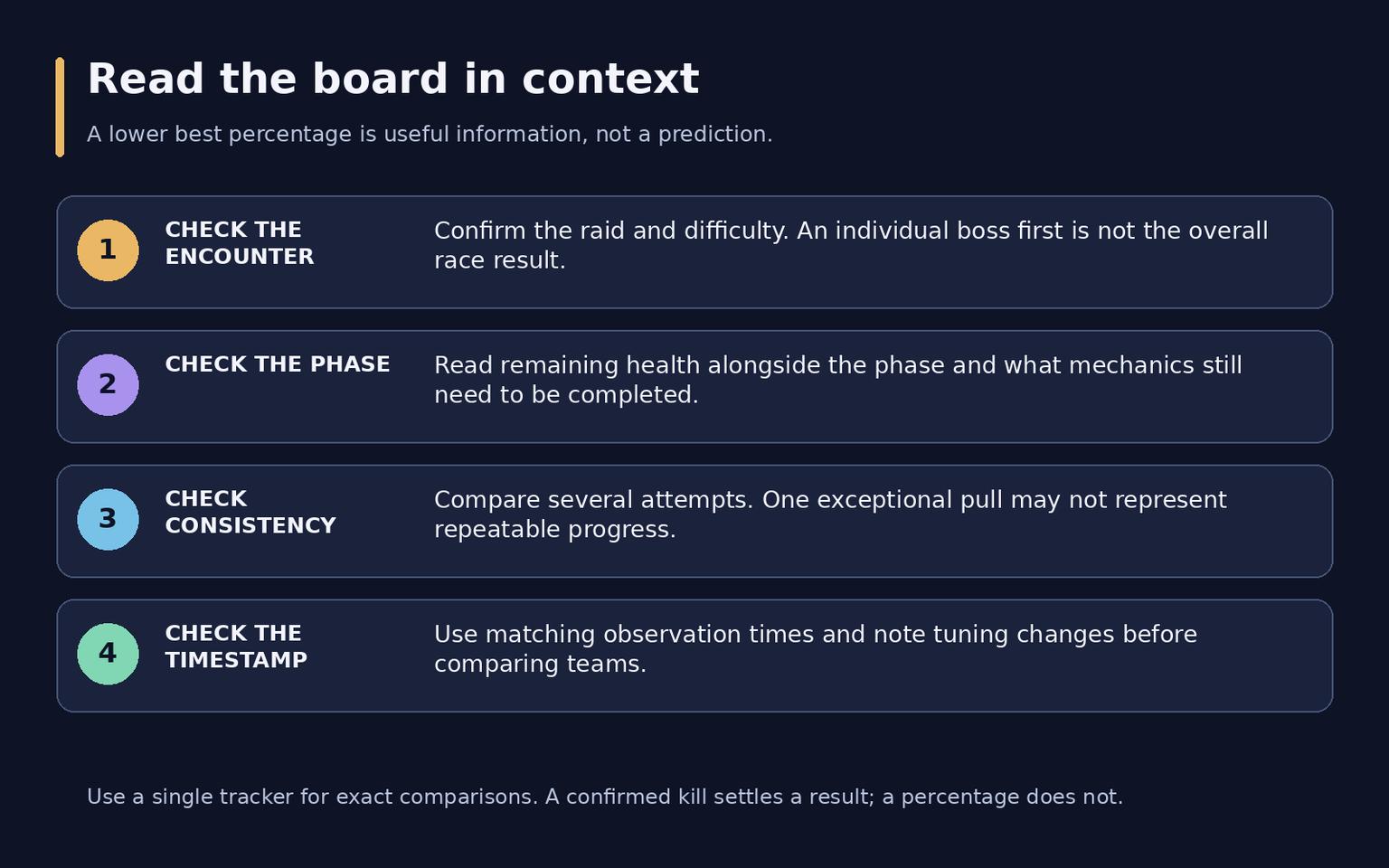
Two teams with the same number of kills may be in very different positions. Check their current encounter, the phase they are reaching and how reliably they repeat a successful sequence.
Metric | What it tells you | What it does not establish |
7/8 | Seven of eight bosses are defeated | That the final kill will happen quickly |
Best remaining boss health | How far one attempt reached | That the team can repeat it consistently |
Pull count | How many attempts the service records | Equal duration or difficulty across those attempts |
Phase and composition | The context of the current attempt | A decisive advantage before the boss dies |
A low remaining-health figure is particularly easy to overvalue. One strong attempt can end with important players dead, followed by a long struggle to reach that point again. A sequence of increasingly repeatable attempts is more informative than one percentage without context.
Another source of confusion is combining numbers from different trackers. Their recorded attempts and update timing may differ. For a precise comparison, use the same service, difficulty and observation time. When data is missing, leave the gap rather than filling it from broadcast chat speculation.
Where to watch and verify results
A useful viewing setup is one main broadcast, one progression board and, when needed, a recording of a specific fight. Constantly switching between every channel can make it harder to understand the changes a team is testing.
Format | Where to look | Best use |
Organization broadcast | Liquid, Echo and Method channels | Commentary, the wider event and player reactions |
Progression rankings | Raider.IO | Kill order and guild comparisons |
Encounter statistics | Warcraft Logs | Compositions, attempts and fight context |
Daily coverage | Wowhead and Blizzard Watch | Important developments without watching a full day |
Channels: Liquid, Echo, Method. Tracking: Raider.IO, Warcraft Logs.
Blizzard's official race announcement provides direct links to organization channels and specialist coverage. After the race, look for recordings and highlights. A channel existing does not mean an RWF broadcast is currently live. Keep the material's date in view when returning later.
For a first viewing, start with the final kill and the previous day's recap. Then watch a few failed attempts immediately before the victory to see what changed. This is an editorial approach to studying recordings, rather than a required viewing order.
Frequently asked questions
Who won Midnight Season 2's Race to World First?
Liquid defeated Ula'tek first on September 3, 2026. Echo placed second and Method third.
Why does another boss World First not decide the winner?
An individual first kill belongs to that encounter. The overall outcome concerns completing the Mythic raid.
Is the race still going?
The first three places in The Venomous Abyss are settled. Other guilds can continue progressing and earn their own positions in the world rankings.
Is the Hall of Fame only for the winner?
No. Blizzard specifies the first 200 guilds worldwide to defeat Mythic Ula'tek. World First means first place, rather than that entire group.
Can the best percentage tell us who will win?
No. It describes an attempt that has already happened. It does not replace a confirmed kill or predict the consistency of the next pull.